
 English
  Portuguese
  Spanish
 In recent years, the way companies consume technology has changed radically. Cloud computing, SaaS platforms, and now artificial intelligence have created a new dynamic, distributed, and highly variable-cost landscape. What used to be a fixed investment in infrastructure is now a living ecosystem of digital services that grows and evolves every minute.
This new model brought speed, flexibility, and innovation. But it also introduced an inevitable challenge: how can we ensure that every dollar spent on technology truly generates business value?
That’s exactly where FinOps comes in.
More than a cost-control methodology, FinOps is an operational framework and cultural practice that helps organizations maximize the value of technology — uniting engineering, finance, and business teams around data-driven decisions.
In other words, FinOps transforms how companies think about, measure, and extract value from technology, fostering collaborative financial responsibility throughout the innovation cycle.
What is FinOps?
FinOps is a cloud financial management practice that enables organizations to maximize the business value of cloud by A Complete Guide to Technology Financial Management for Modern Companies
The massive adoption of cloud technology — and now also SaaS, AI, and digital platforms — has transformed how businesses build, scale, and consume technology. This flexibility has brought agility, but also complexity: variable spending, multiple cost sources, and distributed accountability across teams.
It’s within this scenario that FinOps takes center stage.
Official definition
According to the FinOps Foundation, FinOps is an operational framework and cultural practice that maximizes the commercial value of technology by enabling data-driven decisions and promoting shared financial responsibility across engineering, finance, and business teams.
In short, FinOps is not just a cost-control methodology — it’s a management model that connects technological strategy with financial outcomes, ensuring every technology investment generates real business value.
Why FinOps exists?
Before the digital era, IT costs were more predictable: physical infrastructure, fixed contracts, and little variation in consumption. Today, with on-demand models and multiple providers, the challenge is different — to understand, forecast, and optimize the value of technology as a whole, not just the cost of cloud.
Companies now face:
- Distributed consumption across teams and products
- Variable, hard-to-predict costs
- Lack of real-time visibility
- Misalignment between engineering and finance
The FinOps practice emerges as the bridge connecting technology, finance, and business strategy — creating a common language and a continuous improvement cycle.
| Traditional Infrastructure | Cloud Infrastructure |
| Annual, fixed budgets | Continuous, adaptive forecasting |
| Static infrastructure costs | Variable, usage-based costs |
| Centralized control | Decentralized responsibility |
| Delayed reporting | Near real-time visibility |
| Focus on cost | Focus on technology value |
FinOps doesn’t replace finance or engineering — it integrates both, driving joint, data-driven, value-based decisions.
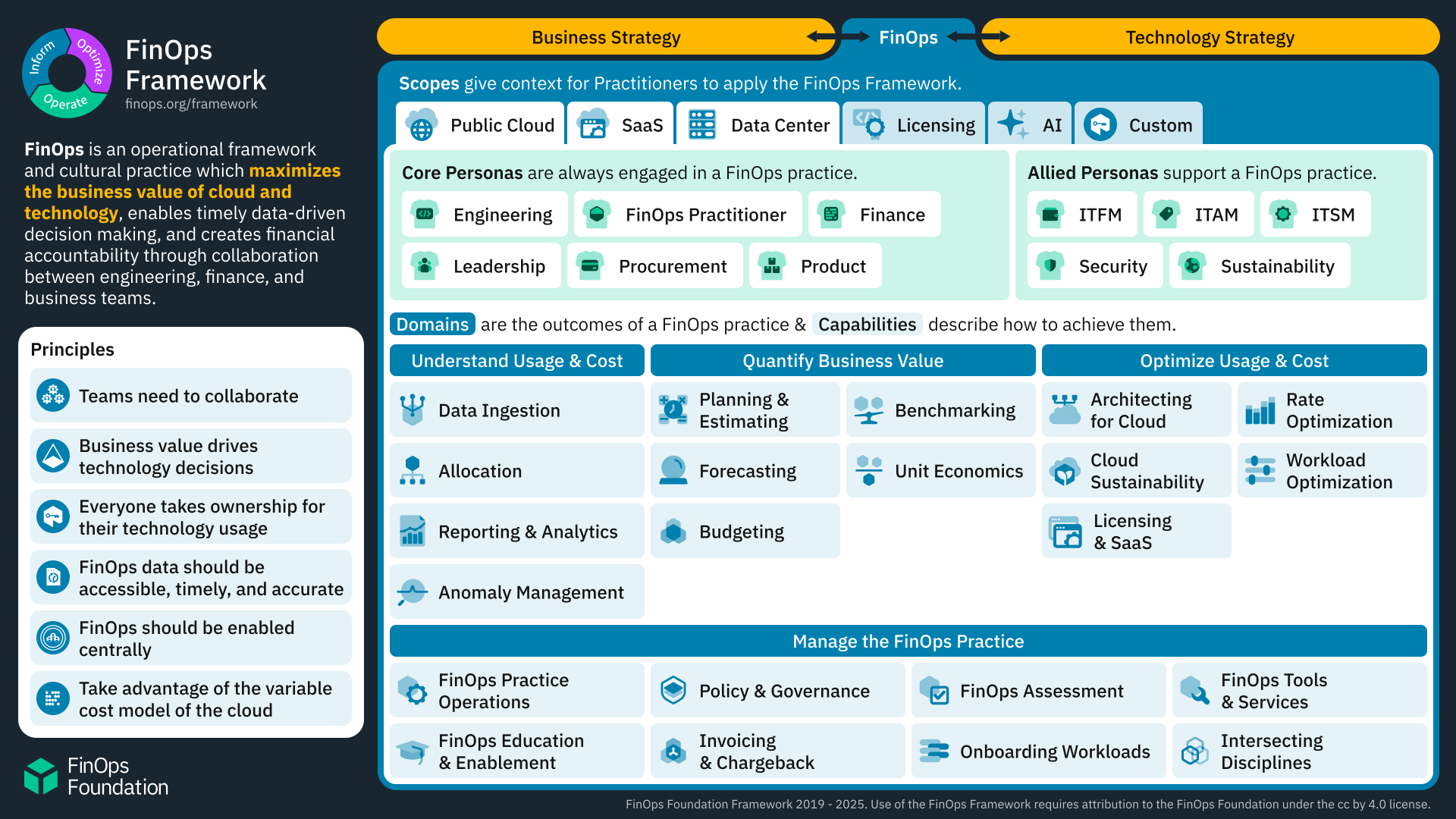
Core FinOps principles
According to the FinOps Foundation, these principles serve as guiding “north stars” and must be applied collectively, not in isolation:
- Teams must collaborate: Finance, technology, product, and business teams work together in near real time to make aligned decisions and drive continuous improvement.
- Business value drives technology decisions: Choices must balance cost, quality, and speed — focusing on business impact, not just expense reduction.
- Everyone is accountable for technology usage: Responsibility for usage and cost is distributed across teams — from design to operations.
- FinOps data must be accessible, timely, and accurate: Cost and usage visibility enables better decisions, forecasts, and optimizations.
- FinOps should be centrally enabled: A central team promotes consistent practices, training, governance, and contract management.
- Leverage the variable cost model of technology: Cloud providers offer mechanisms like Reserved Instances and Savings Plans that should be used to ensure efficient financial management.
The FinOps lifecycle explained
The FinOps journey is continuous and divided into three main phases (as defined by the FinOps Foundation Framework):
Inform
Gain visibility into technology spending, understand usage patterns, and build trust in the data.
Optimize
Identify waste, adjust resources, improve efficiency and performance.
Operate
Establish governance, create forecasts, define metrics, and align investments with business goals.
As organizations mature, they move through this cycle repeatedly, evolving from a cost-focused to a value-focused mindset.
Who is FinOps for ?
The FinOps practice impacts the entire organization:
- Engineering teams: Understands the financial impact of technical decisions.
- Finance teams: Builds more accurate forecasts and adaptive governance.
- Executives: Connects technology investment to strategic results.
- Leadership: Gains clarity on the return on technology investments.
In large organizations, FinOps becomes an organizational competency, not just a function.
Common challenges
Even with the right intent, manEven with the right intentions, many organizations face adoption barriers:
- Unclear accountability
- Disconnected tools and data
- Cultural resistance
- Difficulty measuring value
Overcoming these requires governance, culture, and technology integration, the three pillars of a successful FinOps practice.
Final thoughts
FinOps is no longer just about “cloud cost management”, t’s about technology value realization.
In an increasingly dynamic environment, companies that master FinOps not only save money but also grow with sustainability, predictability, and intelligence.
Adopting FinOps means evolving from controlling spending to creating strategic value with every technology decision.