
 English
  Portuguese
  Spanish
 The cloud introduced a new financial reality for enterprises: costs change constantly, ownership is distributed, and decisions happen fast. Managing this environment requires more than ad-hoc optimization efforts.
This is why most organizations adopt the FinOps lifecycle — a structured, continuous approach to cloud financial management that balances cost, performance, and business value.
In this article, we explain what the FinOps lifecycle is, how it works, and how enterprises apply it in practice.
What Is the FinOps Lifecycle?
The FinOps lifecycle is a continuous framework that helps organizations manage cloud costs through three core phases:
- Inform
- Optimize
- Operate
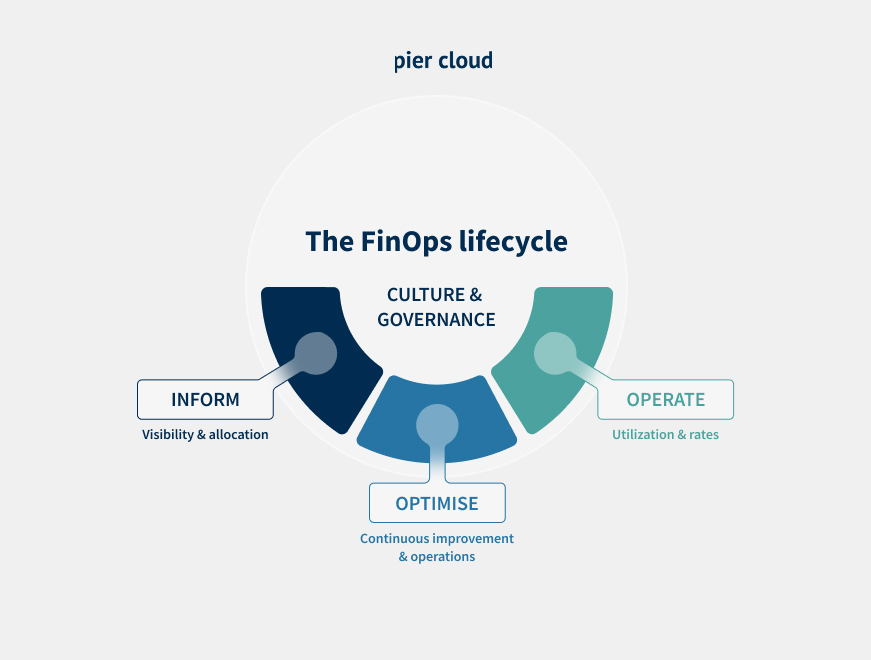
Rather than treating cost management as a one-time initiative, the FinOps lifecycle enables enterprises to continuously improve financial decision-making as cloud environments evolve.
If you’re new to FinOps, start with our foundational guide:
What Is FinOps? A Complete Guide to Cloud Financial Management
Phase 1: Inform — Creating Cost Visibility and Trust
The first phase of the FinOps lifecycle focuses on visibility and transparency.
Enterprises typically start FinOps because they lack clear answers to questions like:
- Where is our cloud spend going?
- Which teams or products are driving costs?
- Are costs aligned with business outcomes?
Key activities in the Inform phase:
- Cost allocation across teams, products, and environments
- Standardized tagging and account structures
- Shared dashboards for engineering, finance, and leadership
- Establishing a single source of truth for cloud cost data
Without this foundation, optimization efforts often fail due to lack of trust in the numbers.
Phase 2: Optimize — Improving Efficiency Without Slowing Innovation
Once visibility is established, enterprises move to the Optimize phase.
Here, the goal is not simply to reduce costs, but to optimize cloud usage based on business priorities.
Common optimization initiatives include:
- Identifying underutilized or idle resources
- Rightsizing compute and storage
- Commitment-based savings (e.g., reserved capacity)
- Architecture and workload optimization
In mature organizations, optimization decisions are driven by FinOps metrics and KPIs, not one-off cost-cutting exercises.
Learn more about how enterprises measure success in FinOps:
FinOps Metrics and KPIs That Matter for Enterprises
Phase 3: Operate — Embedding FinOps Into the Organization
The Operate phase is where FinOps becomes a sustainable practice.
Rather than reacting to costs, enterprises establish processes, governance, and accountability models that support long-term scale.
Operating activities typically include:
- Forecasting and budgeting in dynamic cloud environments
- Governance policies and guardrails
- Continuous reporting and review cycles
- Clear ownership across engineering and finance teams
At this stage, FinOps is no longer a project — it becomes part of the organization’s operating model.
This phase is closely tied to how companies structure their FinOps teams and responsibilities.
How to Build a FinOps Operating Model in Large Enterprises
The FinOps Lifecycle Is Continuous, Not Linear
A common misconception is that organizations “finish” the FinOps lifecycle.
In reality:
- New workloads change cost patterns
- Teams scale and reorganize
- Business priorities shift
As a result, enterprises continuously cycle through Inform → Optimize → Operate, increasing maturity over time.
This is why many organizations evaluate themselves using a FinOps maturity model, rather than a checklist.
Common Challenges Across the FinOps Lifecycle
Enterprises often face similar obstacles at each stage of the lifecycle:
- Inconsistent cost allocation
- Lack of ownership across teams
- Data fragmentation across tools
- Cultural resistance to financial accountability
Addressing these challenges requires alignment between people, processes, and technology — not just tooling.
Final Thoughts
The FinOps lifecycle provides enterprises with a practical way to manage cloud costs without sacrificing agility.
By continuously moving through visibility, optimization, and operational maturity, organizations can:
- Improve financial governance
- Enable better engineering decisions
- Align cloud spend with business value
The lifecycle is not about control for control’s sake — it’s about empowering teams to make smarter decisions in the cloud.