
The FinOps Maturity Model is a framework for assessing how individual FinOps capabilities are practiced and identifying where greater maturity can create business value. It uses three maturity levels—Crawl, Walk, and Run—to help organizations start with the level of complexity they need and progressively evolve their FinOps capabilities.
Importantly, maturity does not mean reaching Run across every capability. Different capabilities can operate at different maturity levels depending on the organization’s needs, technology environment, and business priorities.
In this guide, you’ll learn:
- What the FinOps Maturity Model is
- How Crawl, Walk, and Run work
- How to conduct a FinOps maturity assessment
- How maturity connects to the FinOps Framework and lifecycle
- Which capabilities typically evolve as FinOps matures
- Best practices for advancing FinOps maturity
What Is the FinOps Maturity Model?
The FinOps Maturity Model is part of the FinOps Framework and provides a way to assess how individual FinOps capabilities are currently practiced. It uses three maturity levels—Crawl, Walk, and Run—to describe increasing levels of process maturity, automation, measurement, and organizational adoption.
The model is not a scorecard for the entire organization. A company can operate different FinOps capabilities at different maturity levels, depending on its business priorities and technology environment.
If you’re new to FinOps, start with our foundational guide:
What Is FinOps? A Complete Guide to Cloud Financial Management
Why the FinOps maturity model matters
Many organizations successfully implement dashboards and reporting but struggle to move beyond basic visibility.
This happens because visibility alone does not create accountability.
Without clearly defined ownership, governance, and collaboration between finance and engineering, cloud spending remains reactive rather than strategic.
The FinOps Maturity Model provides a roadmap for closing that gap.
Instead of approaching cloud cost management as a series of isolated optimization projects, organizations build repeatable capabilities that improve continuously over time.
For enterprise organizations, this approach delivers several advantages.
Better financial visibility
Teams gain confidence in cloud billing data through consistent allocation strategies, standardized tagging, and reliable reporting.
Improved engineering accountability
Rather than centralizing cost management within finance, engineering teams gain direct visibility into the financial impact of their architectural decisions.
Stronger governance
Organizations establish policies that encourage responsible cloud usage without slowing engineering velocity.
Better forecasting
As financial data becomes more accurate, finance leaders can predict cloud spending with greater confidence and improve budget planning.
Greater business alignment
Cloud investments become easier to evaluate using metrics such as unit economics, product profitability, and customer acquisition costs.
Ultimately, FinOps maturity enables organizations to move from reactive cost management to proactive financial decision-making.
Understanding the three stages of FinOps maturity
The FinOps Foundation organizes maturity into three progressive stages:
- Crawl
- Walk
- Run
The FinOps Maturity Model uses three levels to describe how mature a specific FinOps capability or activity is: Crawl, Walk, and Run.
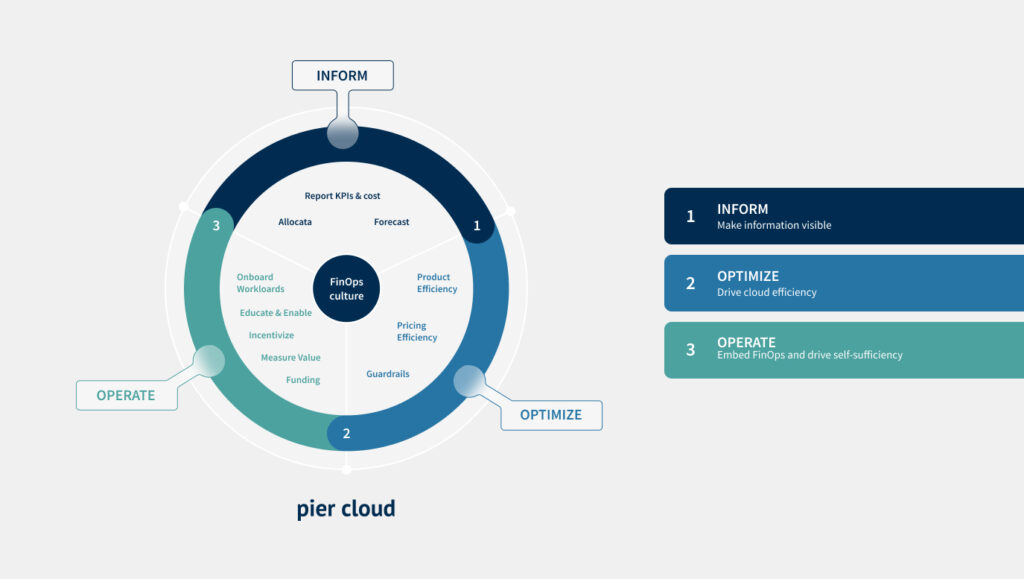
These maturity levels should not be confused with the FinOps Lifecycle, which consists of Inform, Optimize, and Operate. The lifecycle describes the activities teams perform as part of FinOps, while the maturity model describes how consistently, effectively, and extensively those capabilities are practiced.
Organizations may also have different maturity levels across different capabilities. For example, cost allocation may be at Walk while forecasting remains at Crawl.
Stage 1: Crawl — Building visibility and trust
The Crawl stage establishes the foundation for a FinOps capability.
Before organizations can optimize cloud spending, they must first understand where costs originate, who owns them, and whether the underlying financial data can be trusted.
At this stage, cloud environments often grow faster than financial processes.
Engineering teams deploy resources independently, tagging standards vary across business units, and finance teams struggle to allocate costs accurately.
As a result, organizations frequently experience:
- Limited cost allocation
- Inconsistent tagging
- Manual reporting
- Spreadsheet-based analysis
- Reactive optimization efforts
- Limited engineering participation
Because ownership is still centralized, cloud financial management usually remains the responsibility of a small FinOps, IT, or finance team.
Primary objectives during the Crawl stage
Organizations should focus on building a reliable financial foundation.
Key priorities include:
- Establish standardized tagging policies
- Improve cloud cost allocation
- Create consistent reporting processes
- Increase visibility across teams
- Build trust in billing and usage data
At this point, optimization is not the primary goal.
Instead, success depends on creating confidence that financial information is accurate enough to support future decision-making.
Typical capabilities
Organizations operating at the Crawl stage often have:
- Basic cloud cost dashboards
- Monthly or weekly reporting
- Initial tagging policies
- Manual allocation processes
- Limited forecasting capabilities
- Centralized ownership
Common challenges
The biggest obstacle during this stage is poor data quality.
Without consistent allocation, engineering leaders cannot understand how infrastructure supports products or customers.
Finance teams also struggle to answer seemingly simple questions such as:
- Which product generates the highest cloud costs?
- Which teams own the largest workloads?
- How much does it cost to support a specific customer?
Without reliable answers, optimization efforts remain largely reactive.
Stage 2: Walk — Embedding accountability across teams
Once organizations establish trusted visibility, the next challenge is transforming information into action.
Organizations in this stage typically demonstrate several improvements over the foundational Crawl stage.
Rather than treating cloud financial management as a finance responsibility, organizations begin embedding accountability across engineering, product, operations, and business teams.
Cloud cost data becomes part of everyday decision-making instead of monthly reporting.
Engineering leaders start evaluating architectural choices alongside performance, reliability, and scalability. Finance teams shift from explaining invoices to partnering with engineering on financial planning. Product teams begin understanding the cost of delivering individual services, features, or customer experiences.
This evolution represents one of the most significant cultural shifts in the FinOps journey.
Characteristics of the Walk Stage
Organizations in this phase typically demonstrate several improvements over the foundational Crawl stage.
Cloud costs are no longer viewed as a finance-only concern. Teams across the organization share responsibility for improving efficiency while maintaining engineering velocity.
Common characteristics include:
- Consistent cost allocation across cloud resources
- Shared KPIs between Finance and Engineering
- Showback or chargeback programs
- Regular cloud optimization reviews
- Forecasting based on historical trends
- Increased executive visibility into cloud investments
Most importantly, optimization becomes proactive rather than reactive.
Instead of investigating unexpected cloud bills after they arrive, organizations continuously monitor spending patterns and identify opportunities before costs escalate.
Primary Objectives
During the Walk stage, organizations focus on improving operational efficiency while strengthening financial accountability.
Key priorities include:
- Expanding ownership beyond the FinOps team
- Standardizing optimization workflows
- Measuring engineering efficiency
- Improving forecasting accuracy
- Introducing automation into repetitive FinOps tasks
Optimization also becomes more sophisticated.
Rather than simply identifying idle resources, organizations evaluate the relationship between cost, performance, reliability, and customer experience.
The objective shifts from reducing cloud spend to maximizing the value generated by every cloud investment.
Stage 3: Run — Operating FinOps as a strategic business capability
The Run stage represents a high level of maturity for a specific FinOps capability. At this stage, the capability is embedded into relevant business and technology processes, supported by strong measurement, governance, and automation.
Cloud financial management is no longer a specialized discipline—it becomes embedded into product development, engineering governance, executive planning, and business strategy.
At this level, organizations have established a culture where financial accountability naturally accompanies technical decision-making.
Engineering teams understand the financial impact of architectural choices before deploying workloads.
Finance teams forecast cloud investments with confidence.
Executives evaluate cloud spending using business metrics rather than infrastructure metrics alone.
Characteristics of the Run Stage
Organizations operating at this level commonly demonstrate:
- Near real-time cloud cost visibility
- Highly accurate forecasting
- Mature governance frameworks
- Automated policy enforcement
- Federated ownership across business units
- Product-level cost allocation
- Unit economics integrated into decision-making
- Continuous optimization supported by automation
Financial data becomes a strategic asset instead of an operational report.
Cloud investments can be evaluated against customer acquisition, product profitability, gross margin, or revenue growth.
Instead of asking:
“How much are we spending?”
Organizations ask:
- Which products generate the highest cloud ROI?
- How does cloud investment accelerate customer growth?
- Which engineering initiatives improve long-term margins?
- Where should we invest additional cloud capacity?
This shift fundamentally changes the role of FinOps inside the business.
FinOps capabilities across each maturity stage
While every organization progresses differently, most capabilities evolve in predictable ways.
| Capability | Crawl | Walk | Run |
|---|---|---|---|
| Cost Visibility | Basic dashboards | Organization-wide visibility | Real-time insights |
| Cost Allocation | Partial | Consistent | Product and customer-level allocation |
| Tagging Standards | Emerging | Standardized | Automated governance |
| Forecasting | Limited | Department-level | Enterprise forecasting |
| Optimization | Manual | Continuous | Predictive and automated |
| Chargeback / Showback | Rare | Partial adoption | Fully operational |
| Unit Economics | Not established | Initial adoption | Core business metric |
| Executive Reporting | Monthly | Operational reviews | Strategic decision-making |
| Automation | Minimal | Workflow automation | Intelligent automation |
Notice that maturity is not determined by a single capability.
Organizations may have different maturity levels across different capabilities, depending on their business priorities, technology environment, and desired outcomes.
How to assess your FinOps maturity
One of the biggest misconceptions about the FinOps Maturity Model is treating it as a certification.
There is no passing score.
Instead, organizations should continuously evaluate whether their current capabilities support the business outcomes they need.
A practical assessment begins with a few simple questions.
Visibility
- Can every cloud resource be traced to an owner?
- Are cloud costs allocated accurately?
- Is billing data trusted across the organization?
Accountability
- Do engineering teams understand the cost impact of their decisions?
- Are product owners accountable for cloud consumption?
- Are financial metrics visible outside Finance?
Optimization
- Is optimization proactive or reactive?
- Are optimization opportunities identified continuously?
- Are repetitive FinOps activities automated?
Governance
- Do policies encourage innovation without creating unnecessary friction?
- Are financial guardrails embedded into engineering workflows?
- Can governance scale as cloud environments grow?
Business Value
- Can cloud investments be connected to customer value?
- Do executives measure cloud spending using business outcomes?
- Are unit economics part of strategic planning?
These questions can help organizations establish a baseline for their current FinOps capabilities, identify gaps, and determine where greater maturity could create the most business value.
Different capabilities may operate at different maturity levels, so the assessment should focus on the areas that matter most to the organization’s business and technology priorities.
Common challenges that slow FinOps maturity
Every organization encounters obstacles while scaling FinOps.
The most common challenges are rarely technical. They are organizational.
Poor Cost Allocation
Without accurate allocation, cloud costs remain difficult to interpret.
Engineering teams cannot optimize what they cannot measure.
Treating FinOps as a finance project
FinOps succeeds only when Finance, Engineering, Product, and Leadership share responsibility.
Delegating ownership to a single department limits long-term adoption.
Optimizing without governance
Cost optimization generates temporary savings.
Governance ensures those improvements persist over time.
Organizations that neglect governance often repeat the same optimization work every quarter.
Measuring Business Value, Not Just Cloud Savings
Cloud savings are useful.
Business value is sustainable.
High-performing organizations measure:
- Cost per customer
- Cost per transaction
- Cost per API request
- Product profitability
- Gross margin impact
These metrics connect infrastructure decisions directly to business performance.
How AI is transforming the FinOps maturity model
As cloud environments become more dynamic and complex, traditional FinOps processes can become increasingly difficult to scale. Teams may need to analyze large volumes of cost and usage data, identify anomalies, evaluate optimization opportunities, and monitor governance continuously.
AI can help FinOps teams scale these activities by reducing manual analysis and making financial intelligence more accessible across the organization.
AI can support FinOps maturity by helping teams:
- Detect cost and usage anomalies faster
- Identify optimization opportunities
- Improve cloud cost forecasting
- Analyze large volumes of financial and operational data
- Surface relevant insights for finance, engineering, and business teams
- Automate repetitive FinOps workflows
The role of AI can also evolve as FinOps capabilities mature. At earlier stages, AI may help teams analyze data and identify opportunities. As processes become more structured and reliable, AI and automation can support more continuous monitoring, recommendations, and execution.
For example, a mature FinOps practice can use AI to continuously analyze cloud usage, detect unexpected changes in spending, identify potential optimization opportunities, and provide contextual insights to the teams responsible for taking action.
This does not replace FinOps practitioners. Instead, it allows teams to spend less time gathering and analyzing information and more time making strategic decisions.
Ultimately, AI can help organizations move from periodic FinOps analysis toward more continuous, data-driven financial management—especially when supported by reliable data, clear governance, and well-defined processes.
Best practices for advancing your FinOps maturity
Progressing through the FinOps Maturity Model isn’t about checking boxes or implementing every available tool. It’s about building sustainable capabilities that improve financial decision-making over time.
Organizations that successfully advance their FinOps practice typically share a few key habits.
Build a strong foundation before optimizing
Optimization without reliable data often creates more confusion than value.
Before focusing on savings, ensure your organization has:
- Consistent tagging standards
- Reliable cost allocation
- Clear ownership of cloud resources
- Accurate reporting across cloud providers
A trusted financial foundation makes every future optimization effort more effective.
Make FinOps a shared responsibility
Cloud financial management should never belong exclusively to Finance or Engineering.
The most mature organizations create a shared operating model where:
- Finance provides financial governance and forecasting.
- Engineering owns cloud efficiency.
- Product teams understand the cost of delivering features.
- Leadership aligns cloud investments with business strategy.
This cross-functional collaboration is a defining characteristic of mature FinOps programs.
Measure business outcomes, not just savings
Reducing cloud costs is valuable—but it should never become the primary objective.
Instead, focus on metrics that demonstrate how cloud investments contribute to business performance.
Examples include:
- Cost per customer
- Cost per transaction
- Product gross margin
- Cost to serve
- Cloud spend as a percentage of revenue
- Forecast accuracy
- Unit economics by product
These metrics provide a much clearer picture of whether cloud investments are creating sustainable value.
Automate repetitive FinOps activities
As cloud environments grow, manual processes become increasingly difficult to scale.
Organizations should gradually automate tasks such as:
- Cost allocation validation
- Budget monitoring
- Anomaly detection
- Forecast generation
- Optimization recommendations
- Governance policy enforcement
Automation improves consistency while allowing FinOps teams to focus on higher-value strategic work.
Continuously reassess your maturity
FinOps maturity is not a destination.
Every major business change whether it’s cloud expansion, organizational growth, acquisitions, or new product launches—creates new financial management challenges.
High-performing organizations regularly reassess their capabilities, identify gaps, and refine their operating model to support evolving business priorities.
Continuous improvement is what separates mature FinOps organizations from those that plateau after achieving basic visibility.
Frequently asked questions
What is the FinOps Maturity Model?
The FinOps Maturity Model is a framework developed by the FinOps Foundation that helps organizations evaluate and improve their cloud financial management capabilities. It measures maturity across areas such as visibility, cost allocation, optimization, governance, and collaboration.
What are the three stages of FinOps maturity?
The model consists of three progressive stages:
- Crawl, where organizations establish visibility and reliable cost allocation.
- Walk, where accountability, optimization, and cross-functional collaboration become embedded in daily operations.
- Run, where FinOps becomes a strategic business capability supported by governance, automation, and continuous improvement.
What is the difference between FinOps maturity and the FinOps lifecycle?
How do organizations assess FinOps maturity?
Organizations typically assess their maturity by evaluating capabilities across several dimensions, including:
- Cost visibility
- Resource allocation
- Financial accountability
- Forecasting
- Governance
- Automation
- Business alignment
Rather than assigning a score, the assessment identifies opportunities for improvement and helps prioritize which capabilities should mature next based on business value.
Is FinOps maturity only about reducing cloud costs?
No. While optimization is an important component, mature FinOps organizations focus on maximizing business value.
The ultimate objective is to ensure cloud investments support better engineering decisions, stronger financial predictability, and improved business outcomes.
How long does it take to reach the Run stage?
There is no fixed timeline.
The pace depends on organizational complexity, cloud adoption, executive sponsorship, and the maturity of existing financial and engineering processes.
Many large enterprises spend several years continuously evolving their FinOps capabilities.
Can AI accelerate FinOps maturity?
Yes. AI can significantly reduce manual effort by automating cost analysis, detecting anomalies, improving forecasting accuracy, and providing contextual recommendations to engineering and finance teams.
Rather than replacing FinOps practitioners, AI enables them to focus on strategic decision-making while routine analysis becomes increasingly automated.
Final thoughts
Cloud financial management has evolved far beyond cost reporting.
Today, organizations are expected to make cloud investments with the same discipline they apply to every other strategic business decision.
The FinOps Maturity Model provides a practical roadmap for building that discipline.
Organizations typically begin by creating visibility into cloud spending. As they mature, they establish accountability across Finance, Engineering, and Product teams. Eventually, FinOps becomes part of the organization’s operating model—supporting governance, forecasting, innovation, and long-term business growth.
The most mature organizations understand that FinOps is not about controlling cloud spend.
It’s about maximizing the business value of every cloud investment.
As cloud environments continue to grow in complexity, the next generation of FinOps maturity will be defined not only by visibility and optimization, but by an organization’s ability to combine automation, intelligence, and cross-functional collaboration to make better financial decisions—continuously.
Whether your organization is just beginning its FinOps journey or scaling an enterprise-wide practice, maturity should be viewed as an ongoing evolution rather than a final destination.
The organizations that embrace this mindset will be better positioned to improve cloud efficiency, strengthen financial accountability, and transform cloud spending into a measurable driver of business value.