
Cloud environments change every day. New applications are deployed, workloads scale automatically, engineering teams release new features, and business priorities evolve. As cloud usage grows, so does the complexity of managing its financial impact.
Traditional IT cost management wasn’t designed for this level of speed. Monthly billing reviews and reactive cost-cutting initiatives simply can’t keep pace with dynamic cloud consumption.
That’s why the FinOps Foundation defines the FinOps Lifecycle as a continuous operating model that helps organizations make timely, data-driven decisions about cloud spending. Rather than focusing solely on reducing costs, the lifecycle enables engineering, finance, product, and business teams to work together to maximize the value of every cloud investment.
Whether your organization is just beginning its FinOps journey or looking to mature existing practices, understanding the FinOps Lifecycle is essential for building sustainable cloud financial management.
In this guide, you’ll learn:
- What the FinOps Lifecycle is
- How the Inform, Optimize, and Operate phases work together
- The core capabilities that support each phase
- Common implementation challenges
- Best practices for scaling FinOps across the enterprise
What is the FinOps Lifecycle?
The FinOps Lifecycle is the continuous framework defined by the FinOps Foundation for managing cloud financial operations. It provides organizations with a structured approach to improving cloud cost visibility, optimizing resource utilization, and embedding financial accountability into day-to-day operations.
Unlike traditional cost optimization projects, the FinOps Lifecycle is iterative rather than linear. Organizations don’t complete one phase and move on forever. Instead, they continuously cycle through three interconnected phases:
| Phase | Primary Objective | Typical Outcome |
|---|---|---|
| Inform | Build visibility into cloud spending | Trusted cost data and shared accountability |
| Optimize | Improve cloud efficiency | Better balance between cost, performance, and business value |
| Operate | Establish continuous governance | FinOps becomes part of everyday business operations |
Each phase builds on the previous one, creating a continuous feedback loop that enables organizations to adapt as cloud environments evolve.
This iterative model allows enterprises to respond quickly to changing workloads, new business initiatives, and evolving financial goals without sacrificing engineering velocity.
Why the FinOps Lifecycle matters
Cloud computing fundamentally changed how organizations consume technology.
Instead of purchasing infrastructure upfront, companies now consume resources on demand. While this flexibility accelerates innovation, it also creates a new financial challenge: cloud costs are variable, decentralized, and directly influenced by thousands of engineering decisions made every day.
Without a structured operating model, organizations often struggle with:
- Limited visibility into where cloud spend originates
- Inconsistent cost allocation across teams or products
- Budget overruns caused by unpredictable usage
- Tension between Finance and Engineering
- Reactive optimization efforts that produce only short-term savings
The FinOps Lifecycle addresses these challenges by creating a common operating framework where technical and financial stakeholders collaborate around shared business outcomes.
Instead of asking, “How do we spend less?”, successful FinOps organizations ask:
“How do we maximize the business value generated by every cloud dollar we invest?”
This shift—from cost reduction to value optimization—is what distinguishes mature FinOps practices from traditional cloud cost management.
The three phases of the FinOps Lifecycle
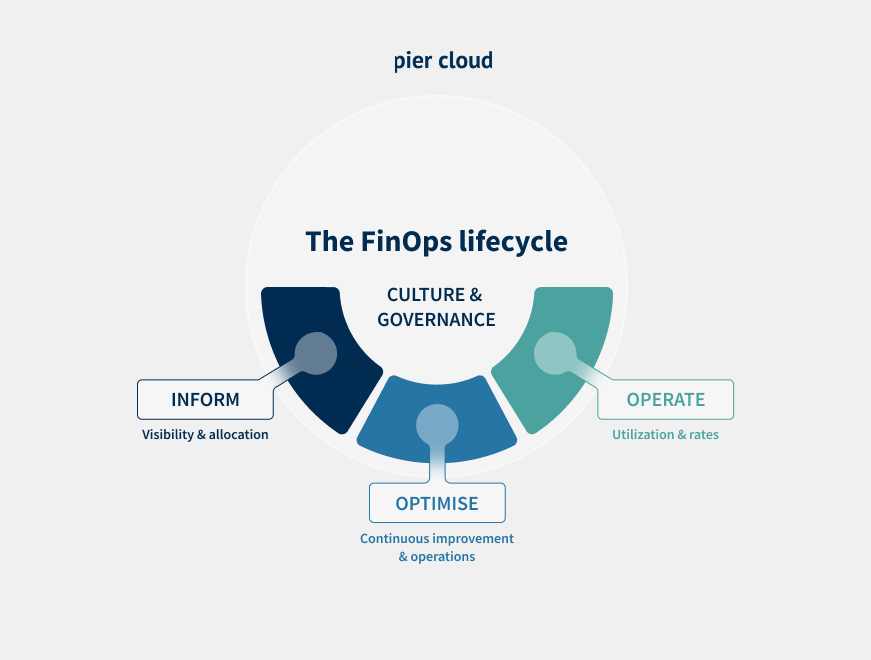
Although the FinOps Lifecycle is continuous, it revolves around three interconnected phases: Inform, Optimize, and Operate. Each phase addresses a different aspect of cloud financial management while reinforcing the others.
Rather than progressing through these phases once, organizations continuously revisit them as cloud environments, workloads, and business priorities evolve.
| Lifecycle Phase | Primary Goal | Key Activities | Business Outcome |
|---|---|---|---|
| Inform | Create visibility and accountability | Cost allocation, tagging, reporting, forecasting, shared dashboards | Trusted financial data for decision-making |
| Optimize | Improve cloud efficiency | Rightsizing, commitment management, workload optimization, architectural improvements | Higher business value from cloud investments |
| Operate | Embed FinOps into daily operations | Governance, automation, budgeting, continuous reviews, policy enforcement | Sustainable financial accountability at scale |
Together, these phases create a continuous feedback loop that helps organizations align cloud spending with business priorities instead of reacting to monthly invoices.
Inform: Building visibility and financial accountability
Every successful FinOps practice begins with visibility.
Organizations cannot optimize cloud spending—or confidently forecast future costs—if they don’t understand where their cloud investments are going or who is responsible for them.
The Inform phase establishes a trusted financial foundation by connecting cloud consumption data with business context. Instead of viewing cloud costs as a single monthly bill, organizations begin to understand how spending maps to teams, products, customers, environments, and business units.
This shared visibility enables Finance, Engineering, and Product teams to make decisions using the same data rather than relying on disconnected reports or assumptions.
What happens During the inform phase?
The primary objective is to create accurate, trusted, and actionable cloud cost data.
Common activities include:
- Establishing cost allocation strategies across teams and business units
- Standardizing resource tagging and account structures
- Mapping cloud costs to applications, products, or customers
- Creating shared dashboards for Engineering, Finance, and leadership
- Improving billing accuracy and financial reporting
- Building forecasting baselines using historical consumption
Organizations with mature FinOps practices go beyond simply tracking cloud bills. They develop the ability to answer critical business questions such as:
- How much does it cost to operate each product?
- Which engineering teams drive the highest cloud consumption?
- How does cloud spending affect gross margins?
- Which customers or services generate the highest infrastructure costs?
- Where are costs increasing, and why?
These insights transform cloud cost data into business intelligence rather than financial reporting alone.
Why cost allocation is the foundation of finOps
One of the most important capabilities developed during the Inform phase is cost allocation.
Without allocating cloud costs to the people, products, or business units responsible for consuming resources, accountability becomes nearly impossible. Engineering teams cannot optimize what they don’t own, and Finance cannot accurately measure profitability or forecast future spending.
Effective cost allocation enables organizations to:
- Improve budgeting accuracy
- Increase financial accountability across engineering teams
- Measure cloud cost per product, customer, or environment
- Support unit economics and profitability analysis
- Build trust in financial reporting
For this reason, many FinOps practitioners consider cost allocation the foundation upon which every other FinOps capability is built.
What success looks like
Organizations are ready to move beyond the Inform phase when they can confidently answer questions such as:
- Do we know where every cloud dollar is being spent?
- Can we attribute costs to the correct teams and business units?
- Do Finance and Engineering trust the same data?
- Can leadership understand cloud spending without manual reconciliation?
Once visibility and trust have been established, organizations can shift their attention from understanding cloud costs to improving how those resources are consumed.
Optimize: Turning cloud visibility into business value
Once organizations have established trusted cost visibility and clear ownership, the next step is transforming those insights into action.
The Optimize phase focuses on improving cloud efficiency without compromising performance, reliability, or innovation. While cost savings are often an outcome, the primary objective is to ensure that every cloud resource delivers measurable business value.
This distinction is important.
Mature FinOps teams don’t ask, “How can we reduce our cloud bill?” They ask:
“How can we make smarter engineering and financial decisions that maximize the return on our cloud investments?”
Every optimization decision involves trade-offs. Eliminating costs at the expense of customer experience or engineering productivity ultimately destroys value. The goal is to optimize cloud usage—not simply minimize spending.
What happens during the optimize phase?
The Optimize phase combines technical analysis with financial context to identify opportunities for improving efficiency across cloud environments.
Common activities include:
- Rightsizing compute, storage, and database resources
- Identifying idle or underutilized infrastructure
- Managing commitment-based discounts, including Reserved Instances and Savings Plans
- Optimizing Kubernetes and containerized workloads
- Reviewing storage lifecycle policies
- Improving workload scheduling and auto-scaling strategies
- Evaluating architectural decisions that impact cloud consumption
- Continuously monitoring usage trends and optimization opportunities
Rather than treating these as isolated projects, mature organizations establish continuous optimization workflows that evolve alongside their cloud environments.
Optimization is about trade-offs, not cost cutting
One of the biggest misconceptions about FinOps is that optimization is synonymous with cost reduction.
In reality, every engineering decision involves balancing multiple priorities, including:
- Cost
- Performance
- Reliability
- Security
- Scalability
- Customer experience
- Time to market
For example, a larger compute instance may increase infrastructure costs while significantly improving application performance and customer satisfaction. Likewise, purchasing long-term cloud commitments may reduce costs but decrease flexibility if workloads change unexpectedly.
Successful FinOps teams evaluate these trade-offs using business context—not cost alone.
The best decision isn’t always the least expensive one. It’s the one that delivers the greatest business value.
Key optimization capabilities
As organizations mature, optimization becomes increasingly proactive rather than reactive.
Some of the most impactful FinOps capabilities include:
Rightsizing Resources
Many workloads are either overprovisioned or underutilized.
Analyzing actual resource consumption allows engineering teams to adjust compute, memory, and storage configurations to better match application requirements, improving efficiency without affecting performance.
Commitment Management
Cloud providers offer significant discounts through long-term purchasing models such as Reserved Instances, Savings Plans, and Committed Use Discounts.
Effective commitment management requires forecasting future demand, monitoring utilization rates, and continuously balancing flexibility with predictable savings.
Workload optimization
Optimization often extends beyond infrastructure sizing.
Engineering teams may redesign application architectures, improve caching strategies, optimize database queries, or modernize services to reduce resource consumption while maintaining—or even improving—performance.
Kubernetes cost optimization
As Kubernetes adoption grows, container cost allocation and cluster efficiency become increasingly important.
Organizations frequently optimize:
- Namespace allocation
- Cluster utilization
- Idle capacity
- Pod scheduling
- Shared infrastructure costs
This ensures containerized environments remain both scalable and financially efficient.
Measuring Success During the Optimize Phase
Optimization efforts should be evaluated using business outcomes rather than isolated savings metrics.
Organizations often track indicators such as:
- Increased resource utilization
- Improved commitment coverage and utilization
- Reduced waste from idle infrastructure
- Better workload efficiency
- More accurate cloud forecasting
- Lower unit costs for products or services
- Improved cloud cost per customer or transaction
These metrics provide a clearer picture of whether optimization initiatives are creating long-term value rather than simply reducing short-term expenses.
Optimization never ends
Cloud environments are constantly changing.
New applications are deployed, engineering teams release features, customer demand fluctuates, and cloud providers introduce new services and pricing models. An optimization completed today may no longer be effective a few months later.
That’s why leading organizations treat optimization as an ongoing capability rather than a periodic initiative.
Continuous monitoring, regular reviews, and close collaboration between Engineering, Finance, and FinOps teams ensure cloud investments remain aligned with evolving business priorities.
As optimization practices mature, organizations naturally transition into the next phase of the FinOps Lifecycle: Operate, where governance, automation, and continuous improvement transform FinOps into a scalable operating model across the enterprise.
Operate: Embedding FinOps into the organization
Organizations don’t achieve FinOps maturity when they complete a successful optimization initiative—they achieve it when FinOps becomes part of how the business operates every day.
The Operate phase transforms FinOps from a series of individual activities into a sustainable operating model. Instead of reacting to cloud costs after they occur, organizations establish governance, processes, and continuous collaboration that enable better financial decisions at scale.
This is where FinOps evolves from a practice into an organizational capability.
Rather than relying on periodic cost reviews, mature organizations build repeatable mechanisms that continuously align cloud investments with business objectives.
Showback vs. Chargeback: which model should enterprises use?
What happens during the operate phase?
The Operate phase focuses on sustaining the improvements achieved during the Inform and Optimize phases.
Organizations typically establish:
- Cloud budgeting and rolling forecasts
- Governance policies and financial guardrails
- Regular business reviews with Engineering and Finance
- KPI tracking and performance measurement
- Continuous cost allocation validation
- Optimization review cycles
- Executive reporting
- Organizational accountability models
The objective isn’t to control engineering decisions—it’s to ensure every team has the information, ownership, and processes needed to make financially informed decisions independently.
This decentralized accountability is one of the defining characteristics of mature FinOps organizations.
Governance enables innovation
Governance is often misunderstood.
Many engineering teams associate governance with approvals, restrictions, and slower delivery. Modern FinOps takes a different approach.
Instead of introducing manual controls, FinOps governance establishes clear policies, shared responsibilities, and automated guardrails that allow teams to innovate confidently while maintaining financial discipline.
Examples include:
- Budget alerts before overspending occurs
- Automated anomaly detection
- Resource FinOps lifecycle policies
- Standardized tagging enforcement
- Commitment utilization monitoring
- Cost allocation validation
- Policy-as-code for cloud financial governance
When implemented effectively, governance reduces friction rather than creating it.
Engineering teams retain autonomy while gaining greater visibility into the financial impact of their decisions.
Forecasting becomes a continuous process
Traditional budgeting assumes relatively stable infrastructure costs.
Cloud doesn’t work that way.
New customer demand, product launches, AI workloads, seasonal traffic, and engineering initiatives can all significantly impact cloud consumption within days.
That’s why mature FinOps organizations replace static annual budgets with continuous forecasting.
Forecasting during the Operate phase combines:
- Historical consumption patterns
- Business growth projections
- Product roadmaps
- Engineering deployment plans
- Commitment coverage
- Seasonal demand
The result is greater financial predictability without sacrificing agility.
Finance gains confidence in future cloud spending, while Engineering gains flexibility to continue innovating.
Collaboration is the operating model
One of the most important principles of FinOps is that cloud financial management is not owned by a single team.
The Operate phase formalizes collaboration across the organization.
| Function | Primary Responsibility |
|---|---|
| Engineering | Build efficient architectures and optimize cloud usage |
| Finance | Forecast spending, measure business impact, and improve financial planning |
| Product | Balance customer value, delivery priorities, and cloud investment |
| Executive Leadership | Define governance, business objectives, and accountability |
| FinOps Team | Connect stakeholders, provide visibility, establish best practices, and drive continuous improvement |
Rather than acting as a centralized approval function, FinOps serves as the connective tissue between technical and financial decision-makers.
This collaborative model enables organizations to move faster while maintaining financial accountability.
Automation is becoming essential
As cloud environments become increasingly dynamic, manual FinOps processes struggle to keep pace.
Thousands of infrastructure changes can occur every day across multiple cloud providers, making spreadsheets and periodic reporting insufficient for enterprise-scale cloud operations.
For this reason, leading organizations are increasingly adopting automation throughout the Operate phase.
Automation can support activities such as:
- Continuous cost monitoring
- Budget and anomaly alerts
- Resource FinOps lifecycle management
- Policy enforcement
- Commitment recommendations
- Executive reporting
- Forecast updates
- Cost allocation validation
By reducing repetitive operational work, FinOps practitioners can spend less time collecting data and more time driving strategic decisions.
The next evolution: AI and Agentic FinOps
The FinOps discipline continues to evolve alongside cloud technology.
While dashboards and reporting remain essential, many organizations are beginning to augment traditional FinOps workflows with AI-driven capabilities.
Instead of simply identifying optimization opportunities, intelligent systems can assist teams by:
- Detecting cost anomalies in real time
- Explaining the business impact of spending changes
- Recommending optimization actions based on workload behavior
- Automating repetitive operational tasks
- Generating forecasts using continuously updated consumption data
This evolution doesn’t replace FinOps practitioners—it amplifies their ability to manage increasingly complex cloud environments.
As cloud adoption accelerates and AI workloads drive higher infrastructure consumption, intelligent automation is becoming a natural extension of the Operate phase, enabling organizations to scale financial governance without increasing operational overhead.
What success looks like
Organizations operating at this stage demonstrate consistent FinOps practices across the business.
Characteristics of a mature Operate phase include:
- Financial accountability is embedded within engineering workflows.
- Cloud spending is continuously monitored and forecasted.
- Governance relies on automated guardrails instead of manual approvals.
- Engineering and Finance make decisions using shared metrics.
- Optimization becomes an ongoing operational capability rather than a periodic initiative.
- Cloud investments are evaluated based on business outcomes—not simply infrastructure costs.
At this point, the FinOps Lifecycle becomes self-reinforcing. Insights generated during day-to-day operations feed back into the Inform phase, uncovering new opportunities for visibility, optimization, and continuous improvement.
Core capabilities that support the FinOps lifecycle
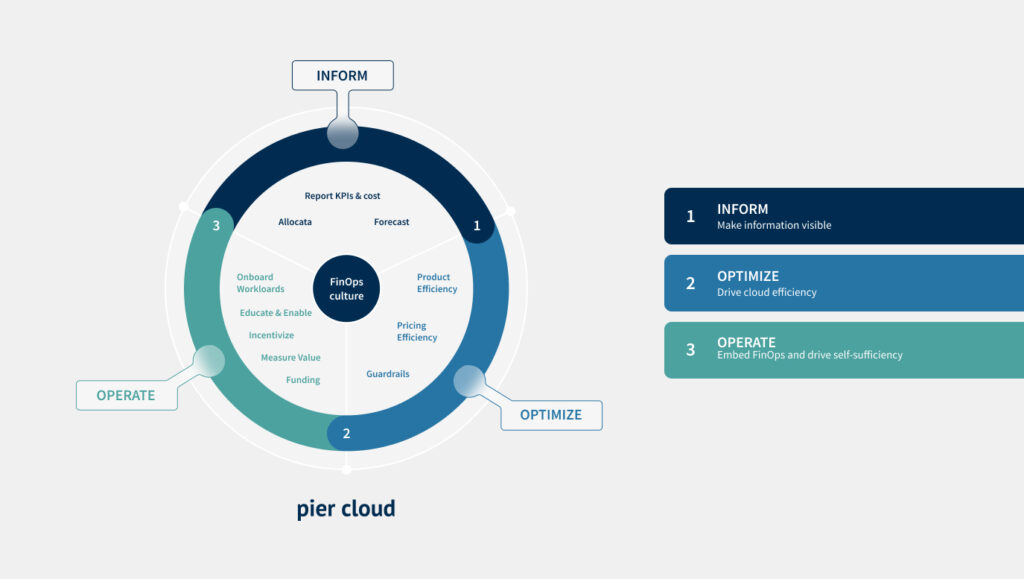
While the FinOps Lifecycle is organized into the Inform, Optimize, and Operate phases, organizations don’t mature by completing these phases alone.
Progress depends on developing a set of core capabilities that enable better financial decision-making over time. These capabilities evolve as FinOps practices mature, supporting every stage of the FinOps lifecycle and helping organizations adapt to changing cloud environments.
Rather than belonging to a single phase, many capabilities span the entire FinOps lifecycle, becoming more sophisticated as the organization grows.
Cost Allocation
Cost allocation is the foundation of every successful FinOps practice.
Without accurately assigning cloud costs to the teams, products, customers, or business units responsible for consuming resources, organizations cannot establish accountability or measure business outcomes.
Effective cost allocation enables organizations to:
- Understand where cloud spending originates
- Measure cloud cost by product or service
- Improve budgeting accuracy
- Support unit economics and profitability analysis
- Enable engineering ownership of cloud costs
As cloud architectures become more complex—particularly with Kubernetes, shared services, and multi-cloud environments—cost allocation also becomes more challenging. Mature organizations continuously refine their allocation strategies to maintain visibility as infrastructure evolves.
Forecasting and budget management
Cloud spending is inherently variable.
Unlike traditional IT infrastructure, cloud costs fluctuate based on customer demand, engineering activity, product launches, and infrastructure changes.
Forecasting helps organizations anticipate future spending instead of reacting after costs have already been incurred.
Modern FinOps forecasting combines:
- Historical consumption trends
- Planned engineering initiatives
- Business growth projections
- Seasonal demand
- Commitment utilization
- Product roadmaps
Accurate forecasts improve financial predictability while allowing engineering teams to maintain the flexibility that cloud computing provides.
Cloud cost optimization
Optimization extends far beyond identifying idle resources.
Mature FinOps organizations continuously evaluate whether cloud resources are delivering appropriate business value relative to their cost.
Optimization capabilities typically include:
- Rightsizing infrastructure
- Commitment management
- Storage optimization
- Compute optimization
- Kubernetes efficiency
- Database optimization
- Workload scheduling
- Architecture improvements
Rather than treating optimization as a quarterly initiative, organizations integrate these practices into ongoing engineering workflows.
Governance and Policy Management
Governance ensures that financial accountability scales alongside cloud adoption.
Instead of relying on manual approvals, mature organizations implement policies and automated guardrails that guide cloud usage without slowing innovation.
Governance capabilities often include:
- Budget controls
- Cost allocation standards
- Resource lifecycle policies
- Tagging requirements
- Compliance monitoring
- Automated policy enforcement
- Financial accountability frameworks
These mechanisms help organizations maintain consistency across teams while reducing operational overhead.
Reporting and Business Insights
FinOps reporting is no longer limited to cloud billing dashboards.
Decision-makers increasingly require business-oriented insights that connect cloud spending to organizational outcomes.
Effective reporting answers questions such as:
- Which products generate the highest infrastructure costs?
- How does cloud spending impact gross margins?
- Which business units are increasing cloud consumption?
- Are optimization initiatives producing measurable results?
- How efficiently are engineering teams utilizing cloud resources?
By translating technical consumption into financial intelligence, reporting enables more informed strategic decisions across Finance, Engineering, and executive leadership.
Unit Economics
As FinOps practices mature, organizations shift their focus from managing total cloud spend to understanding the economics of their business.
Unit economics connects infrastructure costs with business metrics such as:
- Cost per customer
- Cost per transaction
- Cost per API request
- Cost per workload
- Cost per application
- Cost per feature
These insights help leadership evaluate profitability, pricing strategies, and investment decisions with greater confidence.
Rather than asking whether cloud costs increased, organizations begin asking whether increased cloud spending generated proportional business value.
This represents one of the most significant indicators of FinOps maturity.
Automation and Intelligent Operations
Enterprise cloud environments generate more financial and operational data than manual processes can realistically handle.
Automation enables FinOps teams to scale by reducing repetitive work and improving the speed of financial decision-making.
Common automation capabilities include:
- Cost anomaly detection
- Budget monitoring
- Forecast updates
- Optimization recommendations
- Policy enforcement
- Resource lifecycle management
- Executive reporting
- Continuous cost allocation validation
Increasingly, organizations are complementing these capabilities with AI-assisted workflows that help prioritize actions, explain spending changes, and surface optimization opportunities in real time.
Rather than replacing FinOps practitioners, automation enables them to focus on strategic initiatives instead of manual analysis.
Capabilities mature alongside the Lifecycle
No organization develops every FinOps capability at once.
Most begin by improving cost visibility and allocation before expanding into forecasting, optimization, governance, automation, and advanced financial analysis.
As these capabilities mature, the FinOps Lifecycle becomes increasingly effective.
Visibility becomes more accurate.
Optimization becomes more proactive.
Governance becomes more scalable.
And financial decision-making becomes an integral part of how the business operates—not just how cloud costs are managed.
Common challenges enterprises face Throughout the FinOps Lifecycle
Implementing the FinOps Lifecycle is not simply a matter of adopting new tools or creating cost dashboards. It requires organizations to change how technical and financial teams work together to make cloud spending decisions.
As organizations mature, they often encounter similar challenges regardless of their industry, cloud provider, or organizational structure.
Understanding these obstacles—and proactively addressing them—helps organizations accelerate FinOps adoption and maximize business value.
Limited cost visibility
One of the most common barriers to FinOps maturity is incomplete visibility into cloud spending.
Many organizations can see their total cloud bill but struggle to understand:
- Which teams own specific costs
- Which products generate the highest infrastructure expenses
- How cloud investments support business outcomes
- Why spending changes from month to month
Without trusted financial visibility, every optimization initiative becomes reactive.
Improving visibility isn’t about building more dashboards—it’s about creating reliable financial data that everyone across the organization can trust.
Inconsistent cost allocation
Cost allocation remains one of the most difficult capabilities to mature.
Modern cloud environments often include:
- Shared Kubernetes clusters
- Platform teams
- Shared networking services
- Multi-cloud architectures
- AI and data platforms used by multiple business units
These shared resources make it difficult to accurately attribute costs to the products, teams, or customers consuming them.
As a result, engineering teams frequently receive incomplete financial data, making accountability difficult to establish.
Organizations that invest early in consistent allocation models build a much stronger foundation for forecasting, optimization, and unit economics.
Lack of cross-functional ownership
FinOps succeeds when cloud financial management becomes a shared responsibility.
However, many organizations continue to operate in silos.
Finance focuses on budgets.
Engineering focuses on system performance.
Product focuses on customer outcomes.
Each team makes sound decisions within its own context—but without shared visibility, those decisions may not align with broader business objectives.
Successful organizations create a common operating model where Finance, Engineering, Product, Procurement, and executive leadership collaborate around shared metrics and business goals.
Reactive instead of continuous optimization
Many organizations approach optimization as an occasional cost-reduction initiative.
They review cloud spending once a quarter, identify a list of idle resources, implement several recommendations, and then return to business as usual.
Unfortunately, cloud environments change far too quickly for this approach.
New deployments, infrastructure changes, customer growth, and evolving workloads continuously create new optimization opportunities.
FinOps is most effective when optimization becomes part of day-to-day operations rather than a periodic project.
Balancing governance and engineering velocity
Another common challenge is finding the right balance between financial governance and engineering autonomy.
Too little governance can lead to uncontrolled cloud spending, inconsistent resource management, and unpredictable budgets.
Too much governance can slow innovation by introducing unnecessary approval processes and operational friction.
Mature organizations avoid this trade-off by replacing manual controls with automated guardrails.
Instead of requiring approval for every infrastructure change, they establish policies that provide teams with clear boundaries while preserving the flexibility needed to innovate.
Forecasting variable cloud consumption
Unlike traditional IT infrastructure, cloud costs fluctuate continuously.
Factors such as customer growth, AI workloads, product launches, and seasonal demand can significantly impact monthly spending.
Forecasting becomes particularly challenging when organizations rely exclusively on historical billing data.
Leading FinOps teams improve forecasting accuracy by combining historical consumption with business context, including:
- Product roadmaps
- Engineering deployment plans
- Sales forecasts
- Customer growth projections
- Planned infrastructure changes
This broader perspective enables more reliable financial planning while maintaining operational agility.
Scaling finOps across the enterprise
What works for a single engineering team rarely scales across hundreds of applications, multiple business units, or global cloud environments.
As organizations grow, FinOps practices must evolve from individual initiatives into standardized operating models.
Scaling successfully requires:
- Consistent governance policies
- Standardized cost allocation
- Repeatable optimization processes
- Shared performance metrics
- Executive sponsorship
- Automation that reduces manual effort
Organizations that treat FinOps as a strategic business capability—rather than a collection of cost-saving initiatives—are better positioned to sustain long-term success.
Overcoming these challenges
Every organization experiences these challenges differently, but the underlying solution is remarkably consistent.
Successful FinOps programs combine three essential elements:
- People, who collaborate across Finance, Engineering, Product, and leadership.
- Processes, that establish repeatable governance, accountability, and continuous improvement.
- Technology, that provides the visibility, automation, and intelligence needed to operate FinOps at scale.
When these elements work together, organizations move beyond simply managing cloud costs. They create a financial operating model that supports innovation, improves predictability, and enables smarter business decisions.
Conclusion
The FinOps Lifecycle provides organizations with a structured framework for managing cloud financial operations in an increasingly dynamic environment.
Rather than treating cloud cost management as a one-time initiative, the FinOps lifecycle encourages continuous collaboration between Engineering, Finance, Product, and business leaders. Through the Inform, Optimize, and Operate phases, organizations gain the visibility, accountability, and governance needed to make better cloud investment decisions.
As cloud adoption accelerates—and AI workloads continue to increase infrastructure consumption—the ability to continuously align cloud spending with business objectives becomes a competitive advantage.
Organizations that embrace the FinOps Lifecycle don’t simply reduce cloud costs. They build the operational discipline to maximize business value, improve financial predictability, and enable innovation at scale.
The journey doesn’t end after completing a single optimization initiative. FinOps is a continuous practice that evolves alongside your business, helping ensure every cloud dollar contributes to measurable outcomes.