
Cloud computing has fundamentally changed how organizations build, deploy, and scale technology. Instead of investing in fixed infrastructure, businesses now consume cloud resources on demand—unlocking speed, flexibility, and innovation.
But this shift has also introduced a new challenge: cloud spending is dynamic, decentralized, and increasingly difficult to control. Engineering teams can provision infrastructure in minutes, while finance teams struggle to maintain visibility into rapidly changing costs. As cloud adoption expands across AWS, Azure, Google Cloud, SaaS applications, and AI workloads, traditional budgeting methods are no longer enough.
This is where FinOps comes in.
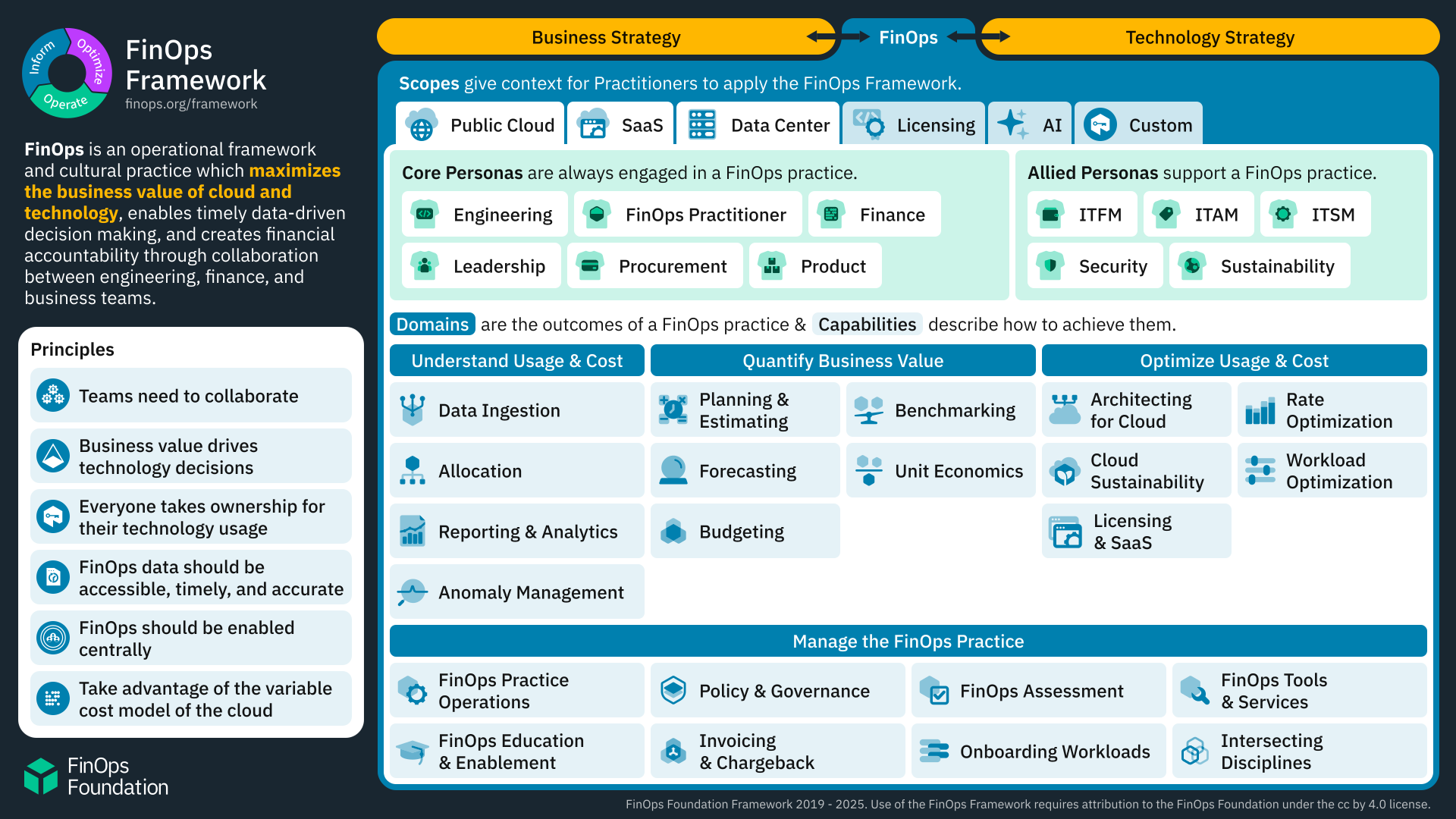
FinOps is more than a cloud cost management practice. It is an operational framework that enables engineering, finance, and business teams to work together, using real-time financial data to maximize the value of every technology investment. Instead of treating cloud costs as a finance problem, FinOps creates a culture of shared accountability where every team understands both the technical and financial impact of its decisions.
Organizations that adopt FinOps don’t simply reduce cloud spend. They improve forecasting accuracy, increase financial visibility, accelerate engineering decisions, and align technology investments with business outcomes.
In this guide, you’ll learn:
How modern enterprises are evolving from cloud cost management to AI-driven FinOps
- What FinOps is and why it matters
- How the FinOps Framework works
- The core principles defined by the FinOps Foundation
- The three phases of the FinOps lifecycle
- The benefits and challenges of FinOps adoption
What is FinOps?
At its core, FinOps (Financial Operations) is a cloud financial management practice that helps organizations maximize the business value of their technology investments. It brings together engineering, finance, product, and business teams to make informed decisions about cloud spending based on real-time data.
Unlike traditional IT financial management, FinOps recognizes that cloud costs are variable, decentralized, and directly influenced by engineering decisions. Every infrastructure deployment, storage configuration, or AI workload has a financial impact. FinOps gives organizations the visibility, governance, and collaboration needed to manage those costs without slowing innovation.
Rather than asking, “How can we reduce cloud costs?”, FinOps encourages organizations to ask a more strategic question:
“How can we maximize the value generated by every dollar invested in technology?”
This shift in mindset is what distinguishes FinOps from traditional cost management. Success is measured not only by lower cloud bills, but by better forecasting, improved unit economics, faster decision-making, and stronger alignment between technology investments and business outcomes.
Today, FinOps extends beyond public cloud infrastructure. Modern organizations increasingly apply FinOps principles to SaaS applications, Kubernetes environments, AI and GPU workloads, data platforms, and other usage-based technologies—creating a unified approach to technology financial management.
The Official FinOps Foundation Definition
According to the FinOps Foundation, FinOps is:
“An operational framework and cultural practice which maximizes the business value of technology, enables timely data-driven decision making, and creates financial accountability through collaboration between engineering, finance, and business teams.”
This definition highlights two ideas that are often overlooked:
- FinOps is an operational framework, not simply a software platform or reporting tool.
- FinOps is a cultural practice, requiring shared ownership of technology spending across the organization rather than centralized cost control by finance alone.
Successful FinOps programs establish a common language between technical and financial stakeholders, allowing organizations to balance cost, performance, reliability, and business growth simultaneously.
FinOps is more than cloud cost management
One of the most common misconceptions is that FinOps is simply another name for cloud cost optimization.
While cost optimization is an important outcome, it represents only one part of the FinOps lifecycle.
A mature FinOps practice helps organizations:
- Gain real-time visibility into cloud and technology spending.
- Allocate costs accurately across teams, products, and customers.
- Improve forecasting and financial planning.
- Optimize cloud resources without sacrificing performance.
- Create accountability across engineering and finance.
- Connect technology investments directly to business value and profitability.
In other words, FinOps is not about spending less—it is about spending smarter.
Why FinOps matters?
Cloud computing has transformed the way organizations consume technology. Instead of purchasing infrastructure upfront, companies now provision resources on demand, scale applications globally within minutes, and pay only for what they use.
This flexibility has accelerated innovation—but it has also made technology spending significantly more complex.
In modern cloud environments, costs fluctuate constantly. Development teams deploy new services daily, Kubernetes clusters scale automatically, AI workloads consume expensive GPU resources, and SaaS subscriptions grow across departments. As organizations expand across AWS, Microsoft Azure, Google Cloud, and other usage-based services, financial visibility becomes increasingly difficult to maintain.
Traditional budgeting processes were never designed for this level of speed and variability.
Without a FinOps practice, organizations often struggle to answer fundamental business questions such as:
- Which products generate the highest cloud costs?
- How much does it cost to serve each customer?
- Which engineering teams are driving cloud spend?
- Are cloud investments improving profitability?
- Where is infrastructure being underutilized?
- Which workloads should be optimized first?
When these questions go unanswered, cloud spending becomes reactive instead of strategic.
Rather than enabling innovation, cloud costs become a source of uncertainty for finance teams and frustration for engineering leaders.
FinOps addresses this challenge by creating a shared operating model where financial data is available in near real time, giving every stakeholder the context needed to make informed technology decisions.
Instead of treating finance and engineering as separate functions with competing priorities, FinOps aligns both teams around a common objective: maximizing business value while maintaining engineering velocity.
Why traditional IT Financial Management no longer works
For decades, IT spending was relatively predictable.
Organizations purchased physical servers, signed long-term software contracts, and planned infrastructure investments months—or even years—in advance. Annual budgets were generally sufficient because costs changed slowly and were managed by centralized IT teams.
Cloud computing fundamentally changed that model.
Today, technology spending is:
| Traditional IT | Cloud & Modern Technology |
|---|---|
| Fixed infrastructure investments | Consumption-based pricing |
| Annual budgeting cycles | Continuous forecasting |
| Centralized purchasing | Decentralized engineering decisions |
| Monthly financial reporting | Near real-time cost visibility |
| Cost control | Value optimization |
| Static environments | Dynamic, auto-scaling infrastructure |
The transition from capital expenditure (CapEx) to operational expenditure (OpEx) has made cloud costs far more dynamic. Every deployment, API call, storage tier, or machine learning workload can affect monthly spending.
As a result, organizations need a financial operating model that evolves as quickly as their infrastructure.
That’s exactly the role FinOps plays.
Rather than relying on static reports produced weeks after spending occurs, FinOps enables continuous financial visibility, proactive governance, and collaborative decision-making across the entire technology organization.
The Business impact of FinOps
Organizations with mature FinOps practices don’t simply reduce cloud costs—they improve the way technology investments support business growth.
A well-established FinOps practice helps organizations:
- Increase cloud cost visibility across teams, products, and business units.
- Improve forecasting accuracy and financial planning.
- Allocate cloud costs more precisely to customers, applications, and services.
- Reduce waste through continuous optimization instead of one-time cost-cutting initiatives.
- Empower engineering teams with financial context without slowing development.
- Strengthen governance while maintaining operational agility.
- Connect cloud spending directly to business outcomes such as gross margin, unit economics, and profitability.
Ultimately, FinOps shifts the conversation from “How much are we spending?” to “What business value are we creating with our technology investments?”
The core principles of FinOps
Successful FinOps programs aren’t built on tools alone. They rely on a set of principles that help organizations create financial accountability without slowing innovation.
The FinOps Foundation defines six core principles that guide how engineering, finance, and business teams collaborate to maximize the value of technology investments.
Together, these principles establish a framework for making faster, smarter, and more financially informed decisions across the organization.
1. Teams need to collaborate
FinOps is fundamentally a team sport.
Cloud spending is influenced by engineering decisions, managed through financial processes, and ultimately measured by business outcomes. No single department has enough context to optimize cloud investments on its own.
Engineering teams understand application performance and infrastructure requirements. Finance teams bring expertise in forecasting, budgeting, and financial governance. Business leaders define strategic priorities and growth objectives.
FinOps creates a common language that enables these groups to make informed decisions together instead of working in silos.
When collaboration becomes part of daily operations, organizations reduce friction, improve accountability, and accelerate decision-making.
2. Business value drives technology decisions
One of the biggest misconceptions about FinOps is that it’s primarily focused on reducing cloud costs.
In reality, mature FinOps organizations evaluate every technology decision based on the business value it creates.
Sometimes the right decision is to optimize infrastructure and reduce unnecessary spending. Other times, increasing cloud investment enables faster product development, better customer experiences, or new revenue opportunities.
The goal is not to spend less.
The goal is to ensure every dollar invested in technology contributes to measurable business outcomes.
This perspective shifts the conversation from cost reduction to value optimization.
3. Everyone takes ownership of cloud spending
Cloud financial accountability shouldn’t rest solely with finance teams.
Every engineering team, product owner, and technology leader should understand how their decisions affect cloud costs.
This doesn’t mean developers become financial analysts. Instead, they gain timely access to cost insights that help them make better architectural and operational decisions.
When financial awareness becomes part of the engineering workflow, organizations move from reactive cost control to proactive cost ownership.
4. Financial data must be timely and accessible
Good decisions depend on accurate information.
Waiting until the end of the month to review cloud invoices makes it difficult to respond to unexpected spending or identify optimization opportunities.
FinOps promotes continuous visibility into cloud usage, cost allocation, and consumption trends, allowing organizations to detect anomalies early, improve forecasting accuracy, and support faster decision-making.
Near real-time financial insights help engineering and finance teams act before small inefficiencies become significant financial problems.
5. FinOps should be enabled through central governance
While accountability is distributed across teams, governance should remain consistent.
Most mature organizations establish a central FinOps function responsible for defining standards, improving cost allocation practices, managing cloud commitments, and promoting financial best practices across the business.
Rather than controlling every decision, this central team provides the governance, education, and operational support that enables decentralized teams to operate effectively.
The result is greater consistency without sacrificing engineering autonomy.
6. Leverage the variable cost model of the cloud
Unlike traditional infrastructure, cloud platforms provide organizations with the flexibility to adjust resources as demand changes.
FinOps encourages businesses to take full advantage of this consumption-based model by continuously optimizing workloads, rightsizing resources, managing commitments such as Reserved Instances and Savings Plans, and eliminating waste where appropriate.
Instead of treating cloud pricing as a fixed expense, organizations learn to actively manage technology investments as dynamic business assets.
This ongoing optimization is one of the defining characteristics of mature FinOps practices.
Why these principles matter?
The six FinOps principles work together to create a culture of financial accountability, continuous optimization, and data-driven decision-making.
Organizations that adopt these principles are better equipped to:
- Improve cloud cost visibility across the business.
- Align engineering and finance around shared goals.
- Strengthen forecasting and budgeting processes.
- Increase cloud efficiency without compromising innovation.
- Connect technology investments to measurable business outcomes.
- Build a scalable FinOps practice that evolves alongside cloud adoption.
Ultimately, these principles transform FinOps from a cost management initiative into a strategic business capability that helps organizations maximize the value of every technology investment.
The FinOps lifecycle
FinOps is not a one-time optimization project—it’s a continuous operating model.
As cloud environments evolve, so do business priorities, engineering workloads, and technology investments. That’s why the FinOps Framework, developed by the FinOps Foundation, organizes cloud financial management into three continuous phases: Inform, Optimize, and Operate.
Rather than following a linear process, organizations continuously move through these phases, improving financial visibility, operational efficiency, and governance over time.
As cloud adoption matures, each cycle helps organizations make faster decisions, reduce waste, and maximize the business value of technology investments.
Phase 1: Inform
The first step in any successful FinOps practice is gaining complete visibility into technology spending.
Organizations can’t optimize what they can’t measure.
During the Inform phase, FinOps teams focus on collecting accurate cloud cost and usage data, allocating expenses across business units, products, applications, and customers, and creating a shared understanding of where money is being spent.
This phase typically includes:
- Cloud cost allocation
- Tagging strategies and governance
- Cost visibility dashboards
- Unit cost reporting
- Showback and chargeback models
- Budget tracking and forecasting
- Financial reporting across cloud providers
The objective isn’t simply to produce reports—it’s to establish trust in the data so that finance, engineering, and business teams can make decisions using a single source of truth.
Without accurate visibility, optimization efforts become reactive and often ineffective.
Phase 2: Optimize
Once organizations understand where cloud spending occurs, they can begin improving efficiency.
The Optimize phase focuses on ensuring cloud resources deliver the highest possible business value while eliminating unnecessary waste.
Optimization extends far beyond deleting idle resources.
Modern FinOps teams evaluate how infrastructure supports application performance, customer experience, scalability, and long-term business goals.
Typical optimization activities include:
- Rightsizing compute resources
- Eliminating idle or underutilized infrastructure
- Optimizing Kubernetes workloads
- Managing Reserved Instances and Savings Plans
- Storage optimization
- Commitment planning
- Workload scheduling
- AI and GPU resource optimization
The objective is not to minimize spending at all costs, but to achieve the optimal balance between performance, reliability, and financial efficiency.
Successful organizations understand that strategic investments in cloud infrastructure often generate greater business returns than short-term cost reductions.
Phase 3: Operate
The Operate phase transforms optimization into an ongoing business capability.
Rather than relying on occasional cost reviews, organizations establish governance processes, automation, policies, and performance metrics that continuously improve cloud financial management.
At this stage, FinOps becomes embedded within everyday operations.
Key activities often include:
- Governance and policy management
- Continuous forecasting
- KPI tracking
- Executive reporting
- Cloud financial planning
- Cross-functional collaboration
- Automation of repetitive FinOps tasks
- AI-driven recommendations and decision support
Operate is where FinOps evolves from a tactical practice into a strategic operating model.
Organizations no longer react to cloud invoices—they proactively manage technology investments as part of broader business strategy.
The FinOps lifecycle never ends
One of the defining characteristics of FinOps is continuous improvement.
Every optimization creates new data.
Every new workload changes spending patterns.
Every product launch introduces additional financial complexity.
For this reason, organizations continuously cycle through Inform, Optimize, and Operate, refining their processes as cloud environments grow.
As FinOps capabilities mature, organizations typically move from answering operational questions such as:“Where are we spending money?”
to strategic questions like:
- Which products generate the highest gross margins?
- How much does it cost to serve each customer?
- Which workloads deliver the greatest business value?
- Where should we invest next to maximize return?
This evolution reflects the true purpose of FinOps: enabling better business decisions not simply reducing cloud costs.
From Visibility to Autonomous Optimization
Historically, organizations relied on dashboards and manual analysis to move through the FinOps lifecycle.
Today, however, the growing complexity of cloud infrastructure, SaaS ecosystems, Kubernetes environments, and AI workloads makes manual FinOps increasingly difficult to scale.
Leading organizations are beginning to augment the FinOps lifecycle with automation and AI.
Instead of simply surfacing insights, intelligent systems can identify anomalies, prioritize optimization opportunities, recommend actions, and support governance in near real time.
This evolution allows FinOps teams to spend less time collecting and interpreting data and more time driving strategic outcomes across the business.
Benefits of FinOps
Organizations don’t adopt FinOps simply to reduce cloud costs—they adopt it to make better technology decisions.
As cloud environments become more distributed and usage-based, financial visibility and cross-functional collaboration become competitive advantages. A mature FinOps practice enables organizations to control complexity, improve operational efficiency, and ensure that technology investments directly support business objectives.
Here are some of the most significant benefits of FinOps.
Improve cloud cost visibility
One of the biggest challenges in cloud financial management is understanding where money is being spent.
Without accurate cost allocation, organizations struggle to determine which teams, applications, products, or customers are driving cloud consumption.
FinOps provides near real-time visibility into cloud spending, allowing engineering and finance teams to identify trends, detect anomalies, and make informed decisions before costs escalate.
Greater visibility also creates trust in financial data, enabling every stakeholder to work from a shared understanding of technology investments.
Increase financial accountability
FinOps replaces centralized cost control with shared financial ownership.
Instead of expecting finance teams to manage cloud costs independently, engineering, product, and business leaders become active participants in financial decision-making.
By giving technical teams access to timely cost insights, organizations create a culture where financial responsibility becomes part of everyday engineering decisions—not an afterthought at the end of the month.
This shared accountability reduces friction between departments and strengthens collaboration across the business.
Improve forecasting and budget accuracy
Traditional budgeting methods often struggle to keep pace with rapidly changing cloud environments.
FinOps enables organizations to build more accurate forecasts by combining historical usage patterns with real-time consumption data.
Rather than relying solely on annual budgets, finance teams can continuously adjust projections as workloads evolve, improving financial predictability and reducing unexpected cloud spending.
This leads to more confident planning, stronger governance, and fewer surprises during financial reviews.
Optimize cloud resources without slowing innovation
Cloud optimization isn’t about using fewer resources—it’s about using the right resources.
FinOps helps organizations identify opportunities to improve infrastructure efficiency through rightsizing, commitment management, storage optimization, workload scheduling, and continuous resource analysis.
Most importantly, optimization occurs without compromising application performance or engineering velocity.
The result is a cloud environment that remains both financially efficient and technically resilient.
Strengthen unit economics
One of the most valuable outcomes of a mature FinOps practice is the ability to connect cloud spending to business performance.
Instead of viewing cloud costs as a single monthly invoice, organizations begin measuring costs per customer, product, transaction, or feature.
This level of financial insight helps leaders answer strategic questions such as:
- Which products generate the highest margins?
- How much does it cost to acquire and serve each customer?
- Which services deliver the greatest return on cloud investment?
- Where should future technology investments be prioritized?
These insights transform cloud spending from an operational expense into a measurable business driver.
Enable better executive decision-making
Executives need more than cost reports—they need business intelligence.
FinOps provides leadership teams with the financial context required to balance innovation, profitability, and long-term growth.
By connecting cloud investments to business outcomes, organizations can make faster, more confident decisions about product expansion, infrastructure strategy, AI adoption, and resource allocation.
Rather than reacting to cloud invoices, leaders gain the ability to proactively guide technology investments toward measurable business value.
Build a scalable financial operating model
As organizations grow, cloud complexity grows with them.
New business units, products, regions, cloud providers, SaaS platforms, and AI workloads all increase the volume of financial data that teams must manage.
FinOps provides the governance, processes, and operating model needed to scale cloud financial management without significantly increasing manual effort.
Instead of relying on spreadsheets and disconnected reporting processes, organizations establish repeatable practices that evolve alongside the business.
FinOps creates long-term business value
While cloud cost optimization is often the first measurable outcome, the long-term value of FinOps extends much further.
Organizations with mature FinOps capabilities typically achieve:
- Better financial visibility across cloud environments
- More accurate forecasting and planning
- Stronger collaboration between engineering and finance
- Greater cloud efficiency
- Improved governance and compliance
- Faster, data-driven decision-making
- Stronger unit economics
- More strategic technology investments
Ultimately, FinOps helps organizations maximize the value of every technology investment while creating the financial discipline required to support sustainable growth.
Putting FinOps into practice
A successful FinOps practice depends on more than tools or cost cuts. It requires repeatable processes, shared accountability, and continuous adaptation as cloud environments change. The foundations are consistent across organizations:
- Clear ownership: responsibilities defined across Engineering, Finance, Product, and leadership, with financial accountability distributed rather than centralized in one team.
- Accurate cost allocation: consistent tagging, ownership models, and shared cost rules, so forecasting, optimization, and unit economics rest on reliable data.
- Accessible financial data: timely cost insights for the people making day-to-day technology decisions, not only for Finance.
- Automation of repetitive work: reporting, budget monitoring, anomaly detection, and commitment tracking, so practitioners can focus on strategic decisions.
- Outcomes over savings: forecast accuracy, allocation coverage, unit economics, and financial predictability, not just lower spend.
For a complete, actionable list organized by the four domains of the FinOps Framework, see our guide to FinOps best practices.
The Future of FinOps: From Visibility to Agentic AI
The next generation of FinOps will be defined not by better dashboards, but by intelligent automation.
Traditional FinOps platforms excel at collecting data and presenting insights. However, they still depend heavily on humans to analyze reports, prioritize opportunities, and coordinate actions across engineering and finance teams.
As cloud environments become more dynamic, this manual approach becomes increasingly difficult to sustain.
Artificial intelligence is changing that.
Rather than simply identifying optimization opportunities, AI-powered FinOps systems can analyze large volumes of cloud and financial data, detect anomalies in near real time, recommend corrective actions, automate repetitive workflows, and continuously improve governance.
This emerging approach—often referred to as Agentic FinOps—marks a shift from reactive financial management to proactive, intelligent operations.
Instead of asking teams to spend hours interpreting dashboards, organizations can empower AI agents to surface insights, prioritize actions, and help teams focus on strategic decision-making.
For enterprises managing increasingly complex cloud environments, this evolution represents more than a technological advancement. It offers a scalable way to improve financial discipline while enabling engineering teams to maintain speed and innovation.
The future of FinOps isn’t simply about understanding cloud costs.
It’s about creating autonomous financial intelligence that helps organizations maximize the value of every technology investment.
Final Thoughts
Cloud computing has fundamentally changed how organizations invest in technology. As infrastructure becomes more distributed, dynamic, and consumption-based, managing technology costs requires far more than monthly billing reports or isolated optimization initiatives.
FinOps provides the operational framework that connects engineering, finance, and business teams around a shared goal: maximizing the value of every technology investment.
Organizations that embrace FinOps gain more than improved cloud efficiency. They build stronger financial accountability, better forecasting, more informed decision-making, and a scalable operating model that supports long-term growth.
As cloud environments continue to evolve with AI, automation, and increasingly complex consumption models, the FinOps discipline will evolve alongside them.
The next generation of cloud financial management won’t simply provide visibility into spending—it will help organizations continuously optimize, govern, and improve technology investments through intelligent automation.
For businesses looking to turn cloud financial management into a strategic advantage, FinOps is no longer optional. It’s becoming a core capability for building efficient, data-driven, and resilient technology organizations.