
Effective AI cost management requires more than tracking token usage or reviewing monthly bills. It also requires connecting consumption to ownership, governance, and business outcomes.
AI FinOps is moving into more products, workflows, and business functions. As adoption grows, organizations must manage a more complex mix of models, providers, workloads, and consumption patterns.
That creates a challenge for Finance and Technology leaders: how do you understand the economics of AI well enough to make informed decisions about investment, usage, and value?
The Tokenomics Foundation’s State of Tokenomics 2026 offers a snapshot of how organizations are approaching that question. The report draws on 472 responses across 11 industries and highlights a gap between adopting AI and confidently connecting its costs to business outcomes.
For FinOps leaders, the findings point to a broader conversation than token prices or monthly bills. They raise questions about attribution, ownership, governance, and how to make technology investment understandable to the people making business decisions.
Here are five signals worth paying attention to.
1. Proving AI value remains a central challenge
The report identifies proving value or ROI as the most frequently named tokenomics challenge: 43% of respondents cited it. Separately, 39% said they were not confident they could connect AI spend to a measurable business outcome their CFO would accept.
These findings highlight a distinction that matters for FinOps: spend visibility is not the same as value measurement.
Knowing how much a workload consumed, which provider was involved, or which team generated the bill helps explain the investment. But it does not, by itself, show whether the investment improved a business process, supported a product, or enabled a measurable result.
The challenge is especially clear when organizations rely on technical consumption metrics alone. Token volume, requests, or model usage can help explain activity, but they may not answer the business questions leaders care about:
- What work did the AI workload support?
- Who used it, and for what purpose?
- What changed as a result?
- Which outcome should be measured for this use case?
- Is the value sufficient to justify the investment?
There is no single output metric that fits every AI workload. A customer support use case, for example, may require different measures from a software development workflow or an internal knowledge tool. The point is to define the relevant outcome for each use case and interpret consumption in that context.
For FinOps, that means extending the conversation from “How much did we spend?” to “What did this investment enable, and how will we assess whether it was worthwhile?”
2. Organizations are asking for transparency, not just lower prices
When respondents were asked what they wanted from model and token providers, 23% requested more transparency and granular data. Only 4% asked for cheaper prices. The report also notes that 19% asked for standards such as FOCUS.
This is a useful signal. Managing AI economics is not simply a procurement exercise. Organizations need enough information to understand what is driving usage and to make that information useful across teams and providers.
Without sufficiently detailed data, it becomes harder to:
- Attribute consumption to the right users, teams, projects, or workloads.
- Explain changes in spend over time.
- Compare usage patterns meaningfully.
- Forecast demand and plan budgets.
- Establish accountability for usage and outcomes.
More granular data does not automatically prove business value. It does, however, provide a stronger foundation for allocation, forecasting, and informed decisions.
This also connects AI economics to established FinOps practices. Allocation and data consistency matter because teams need a shared, trustworthy view before they can make decisions about usage. As organizations consume AI through multiple channels, consistent data becomes increasingly important to understanding the total picture.
The implication is not that every organization needs the same level of detail or the same data model. It is that leaders should identify what information they need to explain usage and support decisions, then assess whether their current data makes that possible.
3. Ownership is becoming a cross-functional question
The report says 88% of respondents have defined ownership for tokenomics. Technology leaders or functions were the most common owners at 35%, followed by shared ownership across functions at 26%. Finance was named as the owner by 5%.
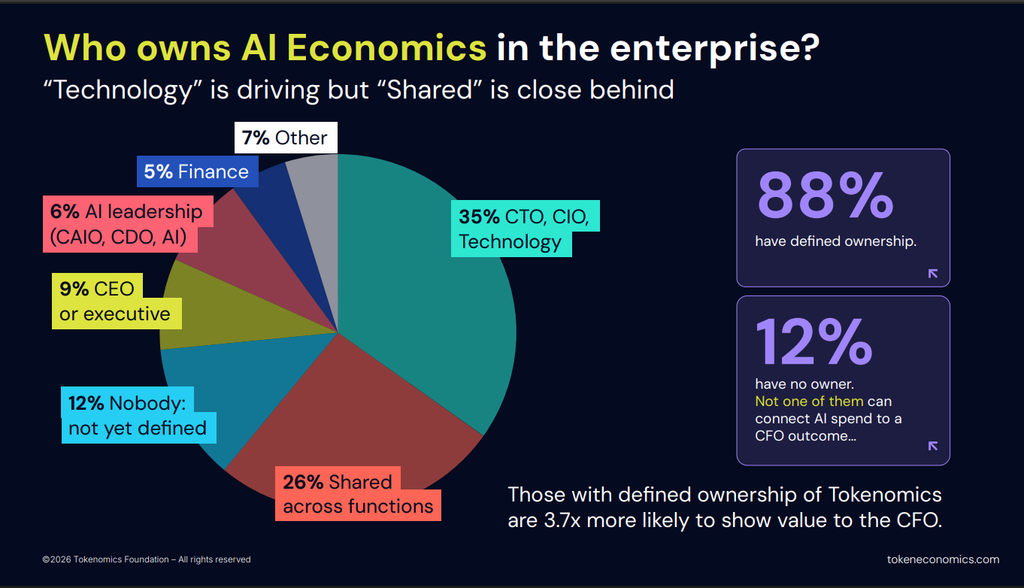
AI economics involves technical choices, financial controls, and business outcomes. That makes ownership more than an organizational chart question.
Technology teams may understand the architecture and usage patterns. Finance may bring forecasting, planning, and accountability. Product and business teams may be best positioned to define what outcomes matter. Each perspective contributes a different part of the picture.
The report also states that organizations with defined ownership were 3.7 times more likely to show value to the CFO. This is a reported association, not proof that assigning an owner causes better outcomes. Still, it underscores the importance of making responsibilities explicit.
A workable ownership model should clarify questions such as:
- Who is responsible for understanding consumption?
- Who defines how usage is attributed?
- Who sets or reviews governance controls?
- Who identifies the outcome a use case is expected to support?
- Who brings usage and outcome information together?
The answer does not have to be a single department. Shared ownership can work when responsibilities and decision rights are clear. Without that clarity, important tasks can fall between teams: Technology may track usage, Finance may see the invoice, and the business owner may be expected to explain value without having access to either view.
FinOps can help create a common operating conversation across those functions. The objective is not to make every decision financial; it is to bring financial accountability and business context into technology decisions.
4. Model routing is attracting attention, but adoption alone does not prove value
According to the report, 86% of respondents are evaluating or using a model router. It also says respondents using routers were four times more likely to report that they could show value to the CFO.
That relationship is worth noticing, but it should not be read as proof that routing by itself creates business value.
Model routing can be part of how organizations select models for different tasks. Its usefulness depends on the use case, the criteria teams apply, and the requirements of the output. Decisions may involve an appropriate balance of cost, quality, performance, or other business and technical needs.
The FinOps question is therefore not simply whether a company uses a router. It is whether its decisions about models and workloads are governed in a way that reflects business requirements and can be reviewed over time.
For example, a team might ask whether a workload has clear criteria for choosing among available models, whether those criteria reflect the needs of the task, and whether usage and outcomes are reviewed after deployment. Those are operational questions, not conclusions that can be drawn from adoption rates alone.
A routing capability can support decision-making, but it does not replace the need for ownership, attribution, or outcome measurement. The broader lesson is to evaluate technology choices in context rather than treating a single capability as a shortcut to value.
5. AI may affect pricing and margins, not just technology budgets
The report says 52% of respondents have already changed their pricing or are considering changes because of AI. Another 30% reported no change, while 18% said it was too early to tell.
This finding expands the AI economics conversation beyond infrastructure and model costs. If AI changes how a product is built, delivered, or consumed, organizations may need to reconsider how costs relate to pricing and margins.
That does not mean every company needs to change its pricing model. The implications will vary by product, customer expectations, and how AI is used. But it does mean that Finance, Product, and Technology may need a shared understanding of how AI consumption relates to the economics of the business.
For example, a business may need to understand whether AI usage is tied to a particular product feature, whether consumption varies significantly by customer or activity, and how those patterns affect internal planning. These are questions about the relationship between technology use and business models, not just the cost of a specific service.
FinOps can help bring those questions into the same conversation as forecasting, allocation, and governance. That is increasingly important when technology decisions may influence not only operating expenses, but also product economics and investment priorities.
What these signals mean for FinOps
Taken together, the findings suggest that AI economics is not just a matter of counting tokens. It brings familiar FinOps questions into a new context:
- Allocation: Can usage be attributed to the right teams, products, workloads, or business activities?
- Visibility: Is the available data detailed and consistent enough to explain consumption?
- Governance: Are responsibilities and controls clear, and do they reflect how the organization uses AI?
- Forecasting: Can teams use what they know about usage to plan for future demand?
- Value measurement: Can AI investment be discussed alongside outcomes that matter to the business?
Organizations do not need to solve every question at once. A practical starting point is to select a specific AI use case and establish a clearer operating view around it.
That can begin with five steps:
- Define ownership. Clarify who is responsible for usage data, financial controls, and outcome measurement.
- Improve attribution. Make AI consumption understandable across the users, teams, workloads, and providers that matter to decision-making.
- Choose meaningful measures. Identify the output or outcome relevant to each use case instead of relying on consumption metrics alone.
- Set governance in context. Establish controls that support appropriate usage and business needs, rather than treating budget limits as the only mechanism.
- Review decisions over time. Use consumption and outcome information to inform choices about workloads, models, and investment.
These steps are not a guarantee of ROI. They help create a more disciplined basis for evaluating AI usage, making trade-offs, and adapting as business needs change.
From explaining spend to making better decisions
The report’s findings point to a gap between having AI usage and confidently explaining its business value. More visibility can help close part of that gap, but visibility alone is not the destination. Organizations also need clear ownership, meaningful attribution, appropriate governance, and measures that connect investment to the purpose of each use case.
The goal is not to reduce AI spend at any cost. It is to make technology investment understandable and governable, so leaders can make better decisions about the value it creates.
That is a broader FinOps opportunity: moving from visibility and analysis toward accountable action. As AI use grows, organizations will need operating practices that connect data, governance, and decisions—not just a clearer bill.
A mature approach to AI cost management helps organizations make informed decisions about technology investment without treating cost reduction as the only measure of success.
Source note: The statistics in this article are findings reported in the Tokenomics Foundation’s State of Tokenomics 2026. They describe survey responses and should not be treated as universal benchmarks. The report page does not provide enough methodological detail to assess the survey’s representativeness.