Gerdau, a NYSE-listed steel producer with 13 industrial units across North America, didn’t stall. FinOps initiatives typically begin with public cloud spending, which is often the first area to experience a massive increase in costs. However, after six to twelve months, a common discrepancy often arises: the cost reported on the FinOps dashboard doesn’t align with the finance team’s ledger. Investigating this gap frequently reveals costs from platforms like Databricks, Kafka, MongoDB, and OpenShift running shared clusters for multiple teams, as well as unmodeled SaaS expenses.
Gerdau’s Multi-Cloud FinOps Transformation: from fragmented spend to trusted accountability
As one of the world’s largest steel producers, Gerdau operates with a vast and complex technology footprint. This infrastructure spans multi-cloud environments (AWS, Azure, OCI) and numerous managed platforms (Databricks, OpenShift/ROSA, MongoDB, Kafka), each with unique billing models, consumption metrics, and cost allocation challenges.
Before their FinOps initiative, Gerdau faced a significantly fragmented cost landscape:
- Invisible Platform Costs: Expenses for SaaS and managed platforms were excluded from the accountability framework, existing only on invoices without proper allocation.
- Manual & Error-Prone Close: The monthly financial close process required intensive, manual efforts to pull data from disparate sources, reconcile varying formats, and apply undocumented or inconsistently enforced allocation rules.
- Eroding Chargeback Trust: The credibility of cost allocation was low, as teams often questioned the fairness due to a lack of auditable and repeatable logic.
- Limited Scope: FinOps efforts were narrowly focused on public cloud, leaving a significant portion of the total technology spend ungoverned.
Gerdau’s objective extended beyond mere “fixing reporting.” The core goal was to establish a trusted accountability operating model, reliable for both finance and engineering teams, capable of scaling across approximately 100 projects and initiatives.
The Insight: Cloud+ demands a new architecture
Expanding FinOps to encompass SaaS and managed platforms is more than a simple data integration challenge. The team discovered it requires four interconnected elements to function effectively:
- Unified cost hierarchy (single taxonomy): A cohesive cost model requires a single taxonomy that spans all platforms. This unified structure must work across diverse naming conventions—from AWS tags and Kubernetes namespaces to Databricks labels and MongoDB database names. Without it, cost allocation devolves into a series of platform-specific workarounds instead of a consistent, logical system.
- Platform-specific, consumption-based metrics: The failure point for many attempts is using the wrong technical metric. A metric must reflect actual usage, not just what’s convenient to measure (e.g., the number of Kafka topics is insufficient). The chosen metric must accurately represent real consumption for each platform.
- Explicit and auditable shared cost rules: Shared infrastructure is unavoidable. Ignoring these costs leaves gaps in allocation, while arbitrary distribution causes internal conflicts. The model requires clear, repeatable, and auditable rules for treating shared costs.
- Joint ownership by finance and engineering: FinOps is not successful as an initiative solely owned by Finance or Technology. Its success depends on genuine co-ownership of the model—including the ongoing governance and backlog—by both departments.
How it was built: platform by platform
Our strategy centers on three core capabilities. First, Integration: we unified SaaS and data platforms directly within Pier Cloud, our FinOps platform. Second, Scale: we expanded our model beyond public cloud to incorporate SaaS and platform costs under a single framework, making visibility consistent and actionable. Third, Financial Automation: by integrating Pier Cloud with SAP Ariba, we transformed cost allocation from a manual monthly task into a fully automated, end-to-end process.
– Thais Minelvino, Global IT Infrastructure & Operations Manager
ROSA / OpenShift
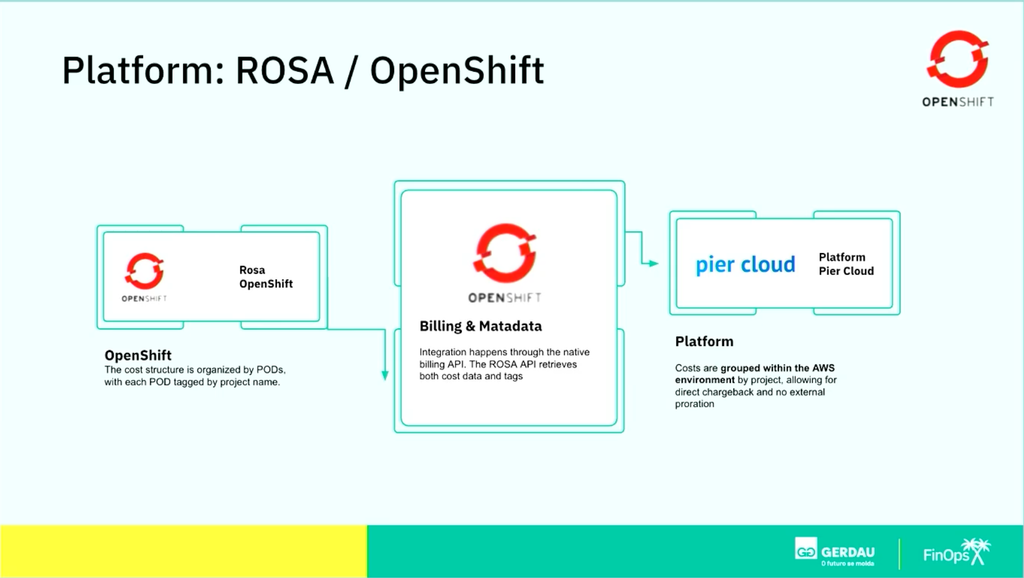
OpenShift resource allocation is managed at the namespace level and incorporates tag-based metadata. A key challenge was the “worker unallocated” cost, which represents infrastructure not easily attributable to a specific team or project.
The resolution involved establishing clear distribution rules for both shared and unallocated costs. Furthermore, a governance backlog was automated to identify and bring untagged resources to the surface for operational correction, moving beyond mere dashboard flagging.
Kafka
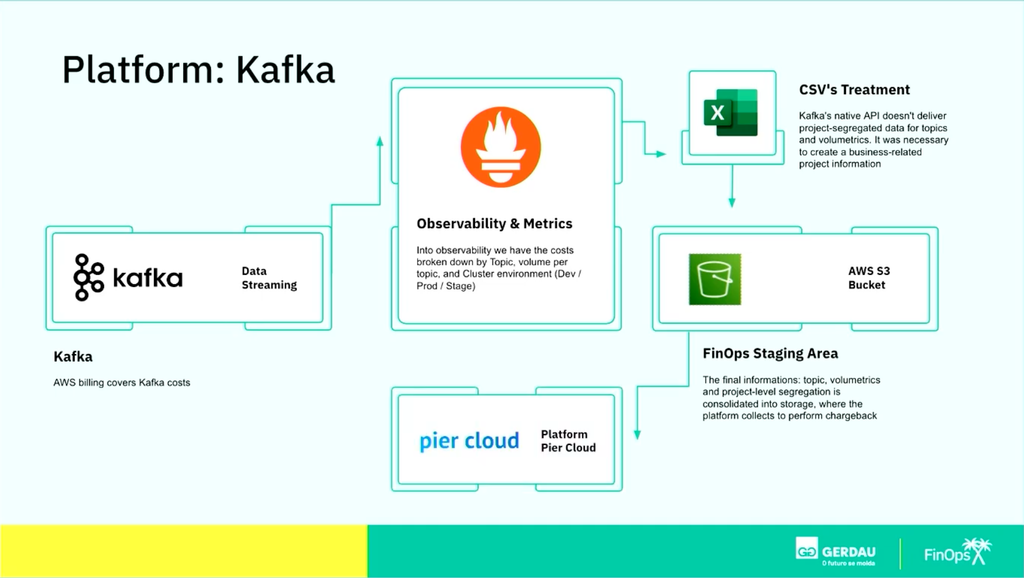
Gerdau initially allocated costs using a simple but flawed model based on the number of topics as a proxy for consumption.
The model was later evolved to incorporate actual usage volumetry. This change, which measures real consumption and applies those percentages to infrastructure costs, resulted in a fairer allocation. This approach significantly reduced disputes from teams, as the charges now accurately reflect their true Kafka footprint.
MongoDB
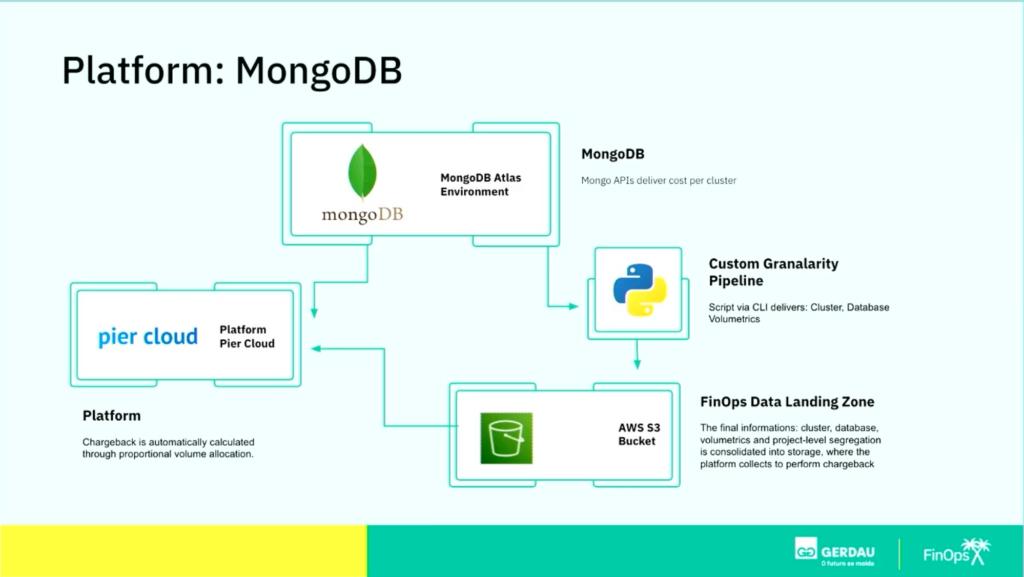
MongoDB faced the common challenge of a shared-cluster environment: numerous projects utilizing the same infrastructure, making a clear separation of costs at the billing level impossible.
To address this, a methodology was developed that integrates billing data with database consumption metrics. This enabled the calculation of project-specific cost percentages, resulting in a model that is both technically sound and fully auditable.
Result: MongoDB costs reduced by ~42% after visibility and targeted optimization.
Databricks
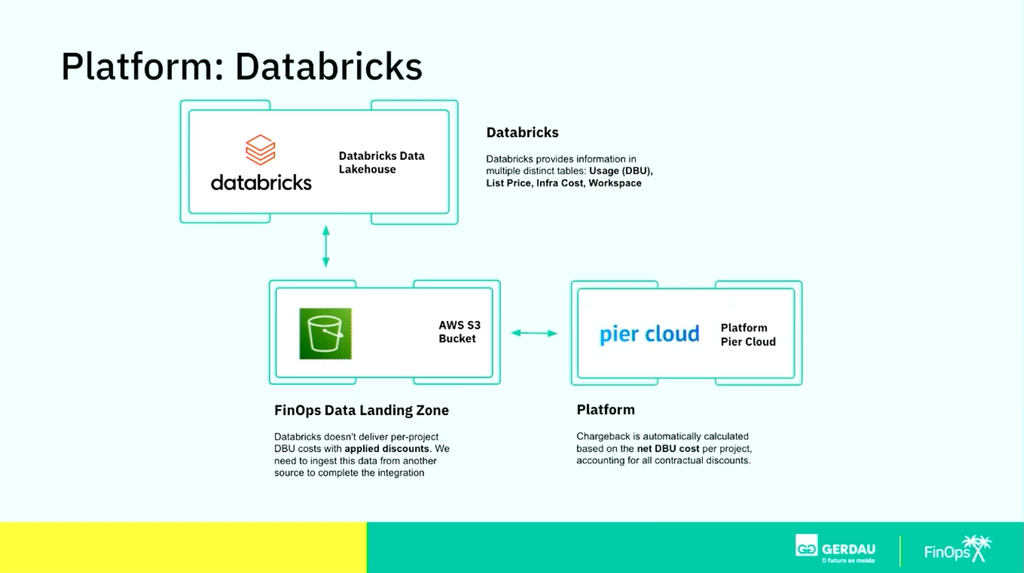
Databricks’ introduction of varied DBU pricing based on service type and discount tier added complexity that simple raw spend allocation couldn’t address.
To overcome this, a new model was developed. This model provides DBU-level visibility by connecting consumption data to specific projects, accurately factoring in the service-level pricing differences. Crucially, this consumption and cost data is linked to unit economics, allowing engineering teams to understand the actual cost of the products they are developing.
Result: Databricks cost reduced by ~49% after visibility and targeted optimization
What changed: the outcomes that matter
Expanding the FinOps scope to include Cloud+ (multi-cloud, SaaS, and managed platforms) yielded significant results across three key dimensions:
1. Governance:
- Allocation rules were formalized as explicit, documented, and repeatable processes.
- The monthly close process transitioned from manual reconciliation to automated distribution.
- Untagged resource governance shifted from reactive cleanup to a proactive, operational backlog.
2. Trust:
- Disputes decreased as teams could understand the logic behind their allocations, and shared costs were distributed based on rules rather than subjective judgment.
- A consensus began to emerge between the Finance team’s reported costs and the Engineering team’s understanding of those numbers.
3. Value:
- Connecting technical consumption signals (like DBUs consumed, Kafka volumetry, and namespace utilization) directly to cost allocation changed the nature of conversations.
- The focus moved from simply questioning “why is our cloud bill going up?” to strategically assessing “what is the actual cost of each initiative, and is it delivering sufficient value?”
4. Scaling chargeback through automation
Gerdau transformed its chargeback process from a highly manual operation into an automated, scalable FinOps workflow.
- 78% Less Operational Effort
336 hours → 72 hours - 28% More Projects Managed
302 → 386 projects - 100% Process Automation
20 spreadsheets → 0
By automating allocation and reconciliation end to end, Gerdau significantly reduced the operational effort required to run its FinOps cycle while expanding the number of projects it could manage.
A big part of the game came from automation. What used to be manual work allocation and reconciliation is now handled end to end by the model, which significantly reduces the time required to run our entire FinOps cycle.
– Thais Minelvino, Global IT Infrastructure & Operations Manager
What doesn’t work: lessons worth keeping
Here are the essential lessons learned, often the hard way, about effective cost allocation:
Foundational rules for successful chargeback:
- Accurate metrics are non-negotiable: Never implement Software as a Service (SaaS) chargeback without an allocation metric that precisely reflects actual consumption. Inaccurate metrics will rightly be rejected by the consuming teams. Getting the technical metric correct is the absolute foundation of the system.
- Explicit rules for shared costs: Undocumented or inconsistent approaches to distributing shared infrastructure costs are a recipe for disputes. Clear, explicit rules for shared costs are necessary to prevent issues that undermine the entire allocation model.
Governance and operational backlog are critical:
- Dashboards are Not Enough: The value of an allocation dashboard is diminished by unresolved governance issues, such as poor tag compliance. A beautiful report is useless if it exposes a credibility gap. The operational work—tracking untagged assets, assigning ownership, and ensuring resolution—is just as important as the reporting layer itself.
What’s next: expanding the scope
The expansion of the Cloud+ model is ongoing, with several key initiatives on the roadmap:
- GitLab: The next phase involves implementing chargeback, building upon the established license governance.
- Datadog: Efforts are underway to revisit allocation automation, following initial constraints caused by API limitations.
- Microsoft 365: The focus is on license optimization and ensuring continuous visibility as the scope incorporates productivity tools.
Pier Cloud collaborated with Gerdau to develop and deploy the Cloud+ operating model. This solution integrates platform capabilities for data ingestion, automated allocation, and unit economics reporting with the implementation expertise necessary to make it functional across numerous SaaS and managed platforms simultaneously.
The underlying technical architecture—featuring a unified taxonomy, platform-specific metric modeling, shared cost treatment, and governance automation—is powered by Pier’s Agent Platform for FinOps. This platform was specifically designed to handle the complexity that arises when FinOps extends beyond the public cloud.
This case study proves more than just the feasibility of Cloud+. It demonstrates that achieving it requires both a platform and a partner who understand that true accountability at scale demands robust modeling, not just simple bill ingestion.